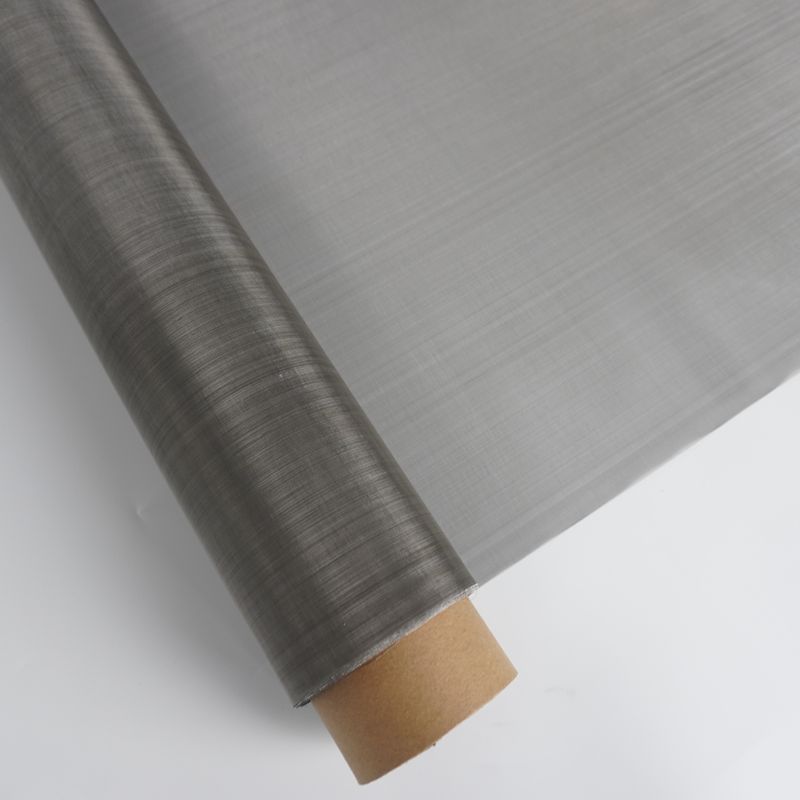
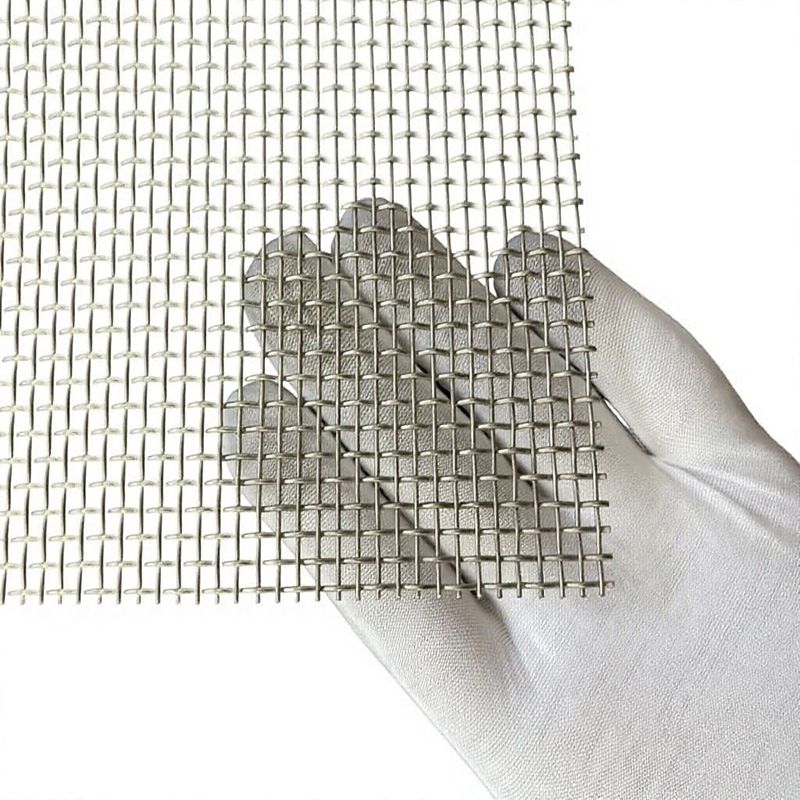
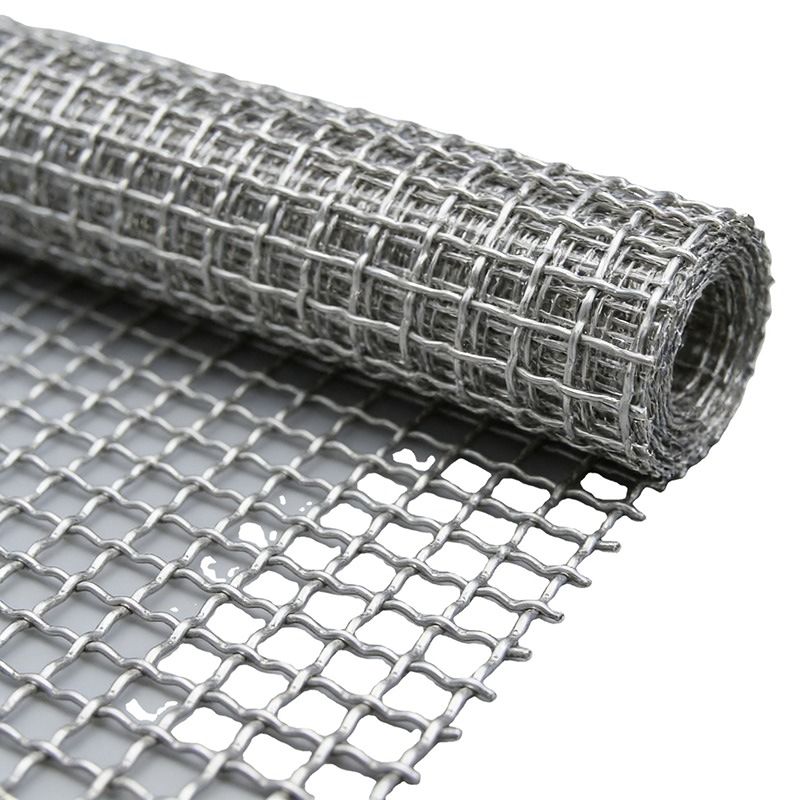
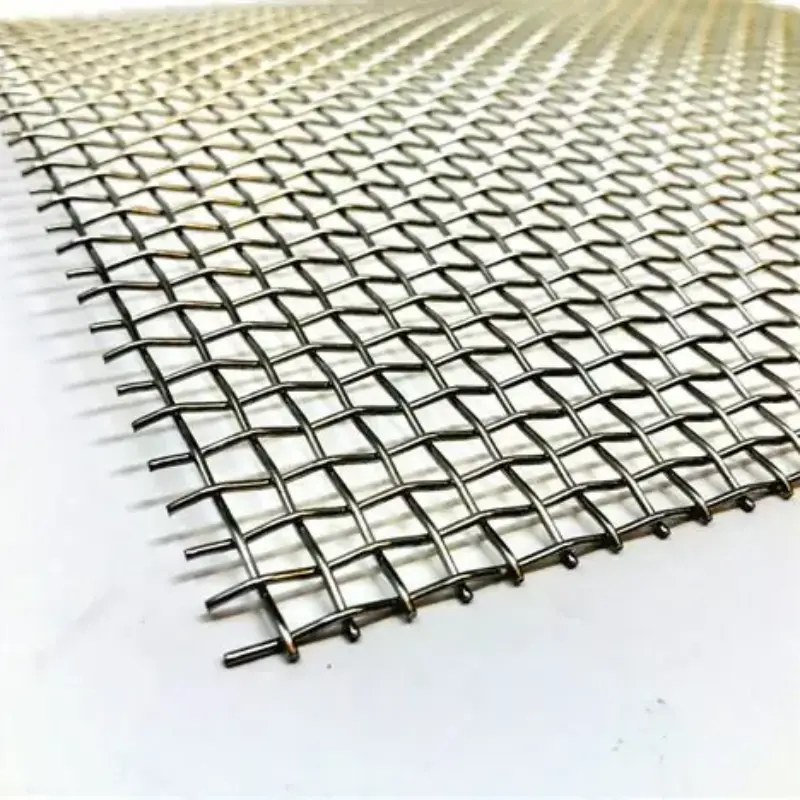
Nichrome Wire Mesh (Nickel-Chromium Resistance Alloy Wire Cloth)
NiCr 80/20, 70/30 and 60/15 – Description, Specifications, Composition, Properties and Applications
1. Product Description
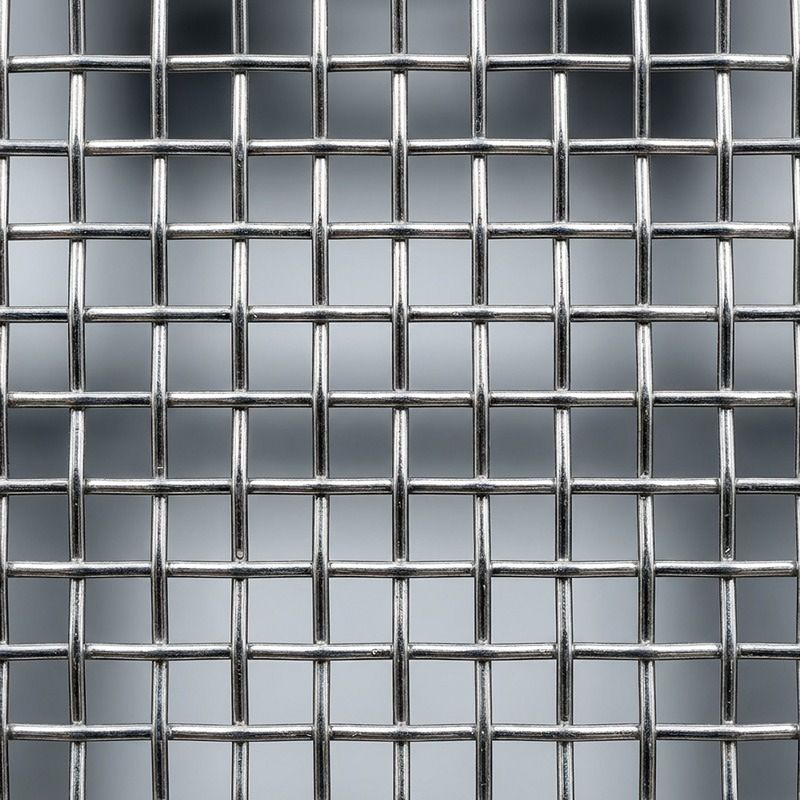
Nichrome wire mesh is the woven wire cloth made from nickel-chromium (NiCr) resistance heating alloy wire. Warp and weft wires are interlaced at right angles on precision wire-weaving looms to form a regular mesh. Nichrome (NiCr, NiCrFe) is the family name for the various alloys of nickel, chromium and often iron; the most common usage is as resistance wire and as heating elements in appliances such as toasters, hot plates and space heaters.
According to chemical composition, the grades most commonly woven into mesh are Cr20Ni80, Cr15Ni60 and Cr20Ni35, corresponding to the NiCr 80/20, NiCr 60/15 and NiCr 35/20 families. Nickel-chromium alloys are austenitic in structure, non-magnetic (the 60/15 grade is only slightly magnetic), and combine high and stable electrical resistivity with excellent oxidation resistance at temperature.
Compared with iron-chromium-aluminium (FeCrAl) heating alloys, nickel-chromium alloys offer higher hot strength, better ductility after service and excellent weldability, but lower maximum operating temperature and higher raw-material cost. They are not subject to the brittle ageing that limits FeCrAl elements, and they resist the formation of a poorly adhering oxide scale.
NiCr 80/20 (Nichrome 80, Ni80Cr20) is the general-purpose grade for electric heating elements in home appliances and industrial furnaces. Because of the extremely good adhesion properties of the surface oxide, it offers superior service life compared with competitive nickel-chromium alloys.
NiCr 70/30 (Nichrome 70, Cr30Ni70) is characterised by high resistivity and good oxidation resistance and is particularly well suited to reducing atmospheres, as it is not subject to green rot. NiCr 60/15 (Nichrome 60, Cr15Ni60) is the standard grade for metal sheathed tubular elements and suspended coils in domestic appliances.
Nichrome wire mesh has outstanding ductility, high tensile strength, oxidation resistance and sulfur resistance. It is supplied as rolls, sheets and fabricated elements for heating, screening and high-temperature filtration duties.
2. Grades and Designations
| Grade |
Ni (%) |
Cr (%) |
Fe (%) |
Max. working temp. (°C) |
Designations / notes |
| Nichrome 80 / NiCr 80/20 |
Rest |
20.0–23.0 |
≤ 1.0 |
1200 |
Cr20Ni80; UNS N06003; W.Nr. 2.4869 |
| Nichrome 70 / NiCr 70/30 |
Rest |
28.0–31.0 |
≤ 1.0 |
1250 |
Cr30Ni70; suitable for reducing atmospheres |
| Nichrome 60 / NiCr 60/15 |
55.0–61.0 |
15.0–18.0 |
Rest |
1150 |
Cr15Ni60 |
| Nichrome 40 / NiCr 40/20 |
34.0–37.0 |
18.0–21.0 |
Rest |
1100 |
Cr20Ni35 family |
| Nichrome 30 / NiCr 30/20 |
30.0–34.0 |
18.0–21.0 |
Rest |
1100 |
Cr20Ni30 |
| Nichrome 20 |
18–21 |
24–27 |
Rest |
1050 |
Chromium-rich, nickel-lean grade |
Grade names are given as published for the nickel-chromium resistance heating alloy family. The same alloys also appear in commerce as NiCr 80/20, NiCr 70/30, NiCr 60/15 and under trade names such as Nichrome, Nichrome A, Nichrome V and Nikrothal. Formal brand equivalences should be confirmed with the supplier before they are quoted to a customer.
3. Chemical Composition (wt %)
| Grade |
Ni |
Cr |
Fe |
C max |
Si |
Mn max |
Reference |
| NiCr 80/20 (Nikrothal 80 type) |
Balance |
19.0–21.0 |
≤ 2.0 (≤ 1.0 on request) |
0.10 |
1.0–1.7 |
1.0 |
High-grade NiCr 80/20 wire |
| NiCr 70/30 (Nikrothal 70 type) |
Balance |
29.0–32.0 |
≤ 5.0 |
0.15 |
0.5–2.0 |
1.0 |
High-grade NiCr 70/30 wire |
| NiCr 60/15 (Nikrothal 60 type) |
57.0–60.0 |
14.0–18.0 |
Balance |
0.10 |
1.0–1.7 |
1.0 |
High-grade NiCr 60/15 wire |
| Cr20Ni80 (GB/T 1234) |
Rest |
20.0–23.0 |
≤ 1.0 |
0.08 |
≤ 1.0 |
≤ 0.6 |
Chinese national standard grade |
| Cr15Ni60 (GB/T 1234) |
55.0–61.0 |
15.0–18.0 |
Rest |
0.08 |
≤ 1.0 |
≤ 0.6 |
Chinese national standard grade |
| Cr20Ni35 (GB/T 1234) |
34.0–37.0 |
18.0–21.0 |
Rest |
≤ 0.10 |
≤ 1.0 |
≤ 1.0 |
Chinese national standard grade |
Values are maximum unless a range is stated. Iron is the balance where "Rest" or "Balance" is shown. Where two different specification systems are given for the same nominal grade, the composition windows differ slightly; the applicable window must be confirmed against the standard or the mill certificate required for the order.
4. Physical and Electrical Properties by Grade
| Grade |
Max. working temp. (°C) |
Melting point (°C) |
Density (g/cm³) |
Resistivity at 20 °C (μΩ·m) |
Elongation min. (%) |
Specific heat (J/g·°C) |
Thermal conductivity W/(m·K) |
CTE α × 10⁻⁶/°C |
Magnetic |
| Nichrome 80 |
1200 |
1400 |
8.4 |
1.09 ± 0.05 |
≥ 20 |
0.46 |
15 |
18 |
Non-magnetic |
| Nichrome 70 |
1250 |
1380 |
8.1 |
1.18 ± 0.05 |
≥ 20 |
0.46 |
15 |
17 |
Non-magnetic |
| Nichrome 60 |
1150 |
1390 |
8.2 |
1.12 ± 0.05 |
≥ 20 |
0.46 |
13 |
17 |
Slightly magnetic |
| Nichrome 40 |
1100 |
1390 |
7.9 |
1.04 ± 0.05 |
≥ 20 |
0.50 |
13 |
19 |
Non-magnetic |
| Nichrome 30 |
1100 |
1390 |
7.9 |
1.04 ± 0.05 |
≥ 20 |
0.50 |
13 |
19 |
Non-magnetic |
| Nichrome 20 |
1050 |
1300 |
7.9 |
1.00 ± 0.05 |
≥ 30 |
0.54 |
12 |
19 |
Non-magnetic |
All grades have an austenitic micrographic structure. CTE = mean coefficient of linear expansion over 20–1000 °C. Resistivity ± 0.05 μΩ·m at 20 °C.
5. Mechanical and Physical Data for High-Grade NiCr Wire
| Property |
NiCr 80/20 type |
NiCr 70/30 type |
NiCr 60/15 type |
| C max (%) |
0.10 |
0.15 |
0.10 |
| Si (%) |
1.0–1.7 |
0.5–2.0 |
1.0–1.7 |
| Mn max (%) |
1.0 |
1.0 |
1.0 |
| Cr (%) |
19.0–21.0 |
29.0–32.0 |
14.0–18.0 |
| Ni (%) |
Balance |
Balance |
57.0–60.0 |
| Fe (%) |
≤ 2.0 |
≤ 5.0 |
Balance |
| Density (g/cm³) |
8.30 |
8.10 |
8.20 |
| Electrical resistivity at 20 °C (Ω mm²/m) |
1.09 |
1.18 |
1.11 |
| Melting point (°C) |
1400 |
1380 |
1390 |
| Max. continuous operating temperature in air (°C) |
1200 |
1250 |
1150 |
| Yield strength Rp0.2, Ø 1.0 mm (MPa) |
420 |
430 |
370 |
| Yield strength Rp0.2, Ø 4.0 mm (MPa) |
300 |
425 |
300 |
| Tensile strength Rm, Ø 1.0 mm (MPa) |
810 |
820 |
730 |
| Tensile strength Rm, Ø 4.0 mm (MPa) |
725 |
800 |
700 |
| Elongation (%) |
30 |
30 |
30 (Ø 4.0) / 35 (Ø 1.0) |
| Hardness (Hv) |
180 (Ø 1.0) / 160 (Ø 4.0) |
185 |
180 (Ø 1.0) / 160 (Ø 4.0) |
| Tensile strength at 900 °C (MPa) |
100 |
– |
100 |
| Creep strength, 1 % in 1000 h: at 800 °C / 1000 °C (MPa) |
15 / 4 |
– |
15 / 4 |
| CTE × 10⁻⁶/K (20–1000 °C) |
17.2 |
17.1 |
17.0 |
| Thermal conductivity at 20 °C (W/m·K) |
15 |
13 |
13 |
| Specific heat at 20 °C (kJ/kg·K) |
0.46 |
0.46 |
0.46 |
| Magnetic properties |
Non-magnetic |
Non-magnetic |
Slightly magnetic |
| Emissivity, fully oxidised material |
0.88 |
0.88 |
0.88 |
Data are reproduced from the published datasheets of a leading NiCr resistance wire range for reference comparison only, and are not a statement of equivalence with any particular Chinese grade. Tensile tests at elevated temperature were performed at a deformation rate of 6.2 × 10⁻²/min.
6. Temperature Factor of Resistivity (NiCr 80/20 type)
| Temp. (°C) |
Factor Ct |
Temp. (°C) |
Factor Ct |
| 100 |
1.01 |
700 |
1.04 |
| 200 |
1.02 |
800 |
1.04 |
| 300 |
1.03 |
900 |
1.04 |
| 400 |
1.04 |
1000 |
1.05 |
| 500 |
1.05 |
1100 |
1.06 |
| 600 |
1.04 |
1200 |
1.07 |
Resistance at temperature = resistivity at 20 °C × Ct. Nickel-chromium alloys have a relatively flat resistance/temperature curve up to about 500 °C and then a slight further rise, which gives stable element performance over a wide temperature range.
7. Wire Mesh Specifications
- Mesh size: 4–325 mesh (wires per inch); a commonly quoted production range for heating mesh is 2–60 mesh
- Wire diameter: 0.0014–0.063 in (approximately 0.036–1.60 mm); heating-element mesh is commonly produced in 0.2–1.2 mm wire
- Width: 0.1 m to 1.5 m
- Length: commonly 30 m rolls; other specifications can be customised
- Weave types: plain weave and twill weave as standard; Dutch weave variants available
- Supply forms: rolls, cut pieces, discs and fabricated elements
- Packaging: paper tube, brown paper, plastic film and wooden box
| Item |
Mesh (wires/in) |
Wire dia. (in) |
Opening (in) |
Open area (%) |
| RNC-01 |
4 × 4 |
0.063 |
0.1870 |
56.00 |
| RNC-02 |
8 × 8 |
0.047 |
0.0780 |
38.90 |
| RNC-03 |
8 × 8 |
0.025 |
0.1000 |
64.00 |
| RNC-04 |
10 × 10 |
0.035 |
0.0650 |
42.30 |
| RNC-05 |
16 × 16 |
0.020 |
0.0430 |
46.20 |
| RNC-06 |
20 × 20 |
0.020 |
0.0300 |
36.00 |
| RNC-07 |
20 × 20 |
0.013 |
0.0370 |
54.80 |
| RNC-08 |
20 × 20 |
0.016 |
0.0340 |
43.20 |
| RNC-09 |
26 × 26 |
0.013 |
0.0260 |
44.00 |
| RNC-10 |
40 × 40 |
0.010 |
0.0150 |
36.00 |
| RNC-11 |
40 × 40 |
0.0070 |
0.0180 |
51.80 |
| RNC-12 |
80 × 80 |
0.0055 |
0.0070 |
31.40 |
| RNC-13 |
200 × 200 |
0.0021 |
0.0029 |
33.60 |
| RNC-14 |
325 × 325 |
0.0014 |
0.0017 |
29.70 |
Standard specification table as published for nichrome woven wire mesh. Other mesh count, wire diameter and roll width combinations can be woven to order.
Woven wire cloth is specified by four interrelated parameters – mesh count, wire diameter, aperture (opening) size and weave type. Any three of these determine the fourth.
| Parameter |
Definition / typical practice |
| Mesh count |
Number of warp (and weft) wires contained in one linear inch of cloth |
| Wire diameter |
Diameter of the individual warp / weft wires, stated in mm or inch |
| Aperture (opening) |
Clear distance between adjacent parallel wires forming one mesh opening, usually stated in mm or inch |
| Open area |
Percentage of the total cloth area that is open; calculated from mesh count and wire diameter |
| Weave type |
Plain weave and twill weave as standard; plain Dutch, twill Dutch and reverse Dutch weave also available |
| Supply forms |
Rolls, sheets, cut discs, and fabricated filter elements (cylinders, baskets, screen packs) |
| Roll width and length |
Width 0.1 m to 1.5 m; length commonly 30 m. Other specifications can be customised |
| Edge type |
Selvedge (woven) edge, cut edge, or reinforced edge |
8. Weave Types
| Weave type |
Construction |
Typical use |
| Plain weave |
Warp and weft wires alternate over and under each other, giving square openings |
General purpose mesh; coarse to medium mesh counts; good mechanical stability |
| Twill weave |
Each weft wire passes alternately over and under two warp wires, staggered on successive warps |
Finer mesh counts; better aperture uniformity and higher open area than plain weave at the same mesh count |
| Plain Dutch weave |
Warp wire diameter is larger than weft wire; the finer weft wires are driven closer to form a tight filter medium |
Fine filtration; the coarse layer reinforces, the fine layer filters |
| Twill Dutch weave |
Combines Dutch and twill weaving; each warp wire passes over and under two fine weft wires, forming tapered openings |
Tight woven mesh with small opening sizes for fine filtration |
| Reverse Dutch weave |
Reverse of the plain Dutch arrangement; smaller warp wires give a tight structure, larger weft wires give higher strength |
Filtration duties requiring extended service life |
9. Key Characteristics
- High and stable electrical resistivity, with a low temperature coefficient of resistance
- Excellent oxidation resistance at high temperature
- Good corrosion resistance and sulfur resistance
- Sufficient high-temperature strength, with useful creep strength at 800–1000 °C
- Good ductility, including good ductility after service
- Excellent weldability and good processability
- Austenitic structure; non-magnetic, except the 60/15 grade which is only slightly magnetic
- High emissivity of the fully oxidised surface (about 0.88), giving efficient radiant heat transfer
- Permeability resistance and superior elongation
- NiCr 80/20 offers extremely good adhesion of the surface oxide, which gives superior service life compared with competitive nickel-chromium alloys
- NiCr 70/30 is not subject to green rot and is therefore particularly well suited to reducing atmospheres
10. Oxidation, Corrosion and High-Temperature Performance
- The working temperature range of the nickel-chromium family is approximately 950–1250 °C depending on grade; the published maximum continuous operating temperature in air is 1200 °C for NiCr 80/20, 1250 °C for NiCr 70/30 and 1150 °C for NiCr 60/15
- Green rot is a form of catastrophic localised oxidation that can occur in nickel-chromium alloys under cycling oxidising / reducing conditions, particularly in atmospheres with low oxygen and high carbon content. NiCr 70/30 with its higher chromium content is not subject to green rot and should be selected for reducing atmospheres
- Sulfur-bearing atmospheres attack nickel-chromium alloys; the sulfur resistance of nichrome mesh is good but the actual sulfur level, temperature and gas composition must be reviewed when selecting a grade
- Nickel-chromium alloys are austenitic and are not subject to the low-temperature brittle ageing that affects iron-chromium-aluminium heating alloys, so elements retain ductility after service and are easier to handle and repair
- Maximum element temperature in service depends on wire diameter, surface load, atmosphere and support arrangement, not on the alloy alone; the values above are material limits in air
- Rapid heating and cooling cycles, and any mechanical loading while hot, should be taken into account when designing a mesh heating element
11. Typical Applications
- Electric heating elements in high-temperature furnaces
- Heating elements in household appliances: toasters, hot plates, grills, toaster ovens, storage heaters, space heaters and water heaters
- Metal sheathed tubular elements and cartridge elements
- Suspended coils in air heaters for clothes dryers, fan heaters and hand dryers
- Flat irons, ironing machines, soldering irons and plastic moulding dies
- Electrical heating elements of plastic extruders, including 3D printer hot ends
- Heating coils of electronic cigarettes
- Bridgewire in electric ignition systems such as electric matches and model rocket igniters, and in the explosives and fireworks industry
- Industrial and hobby hot-wire foam cutters
- Internal support structure in ceramic work, holding clay sculptures in shape during kiln firing
- Motorcycle mufflers
- Microbiological laboratory apparatus
- Solar panel deployment mechanism of spacecraft
- Aerospace, shipbuilding, defence, chemical machinery, electric power, desalination and medical apparatus and instruments
- High-temperature screening and filtration where oxidation resistance, sulfur resistance and a stable electrical resistance are required
12. Applicable Standards
- GB/T 1234-2012 – high resistance alloys for electrical heating. Grades covered include Cr15Ni60, Cr20Ni30, Cr20Ni35 and Cr30Ni70
- NiCr 80/20 (Nichrome 80, Cr20Ni80): UNS N06003; W.Nr. 2.4869
- Compliance with GB/T 1234-2012 is commonly declared for Cr20Ni80 and Cr30Ni70 resistance wire
- For the remaining grades, published chemical composition ranges are given in Sections 2 and 3. Brand equivalences for individual suppliers should be confirmed before they are quoted to a customer.
13. Ordering Notes
- Please state grade (NiCr 80/20, 70/30 or 60/15), mesh count, wire diameter, aperture, weave type, roll width and length, quantity and temper when requesting a quotation.
- Where three of the four principal parameters (mesh count, wire diameter, aperture, weave type) are known, the fourth can be calculated and confirmed before order placement.
- Maximum element temperature in service depends on wire diameter, surface load, atmosphere and support arrangement. The values stated in this datasheet are the maximum continuous operating temperatures in air for the material itself and must be confirmed against the actual application.
- Atmospheres with high sulfur content and alternating oxidising / reducing conditions require particular attention. Please state the furnace atmosphere when requesting advice on grade selection.
- All data in this datasheet are typical values given for reference only. Final specification and tolerances are confirmed on the order confirmation.
- Mill test certificates to EN 10204 3.1, third-party inspection and pre-shipment sample approval can be arranged on request.
Supplier
Anping County Bolin Metal Wire Mesh Co., Ltd.
Woven wire mesh, filter cloth and fabricated filter elements.
For quotations, samples and technical support, please contact your account manager.