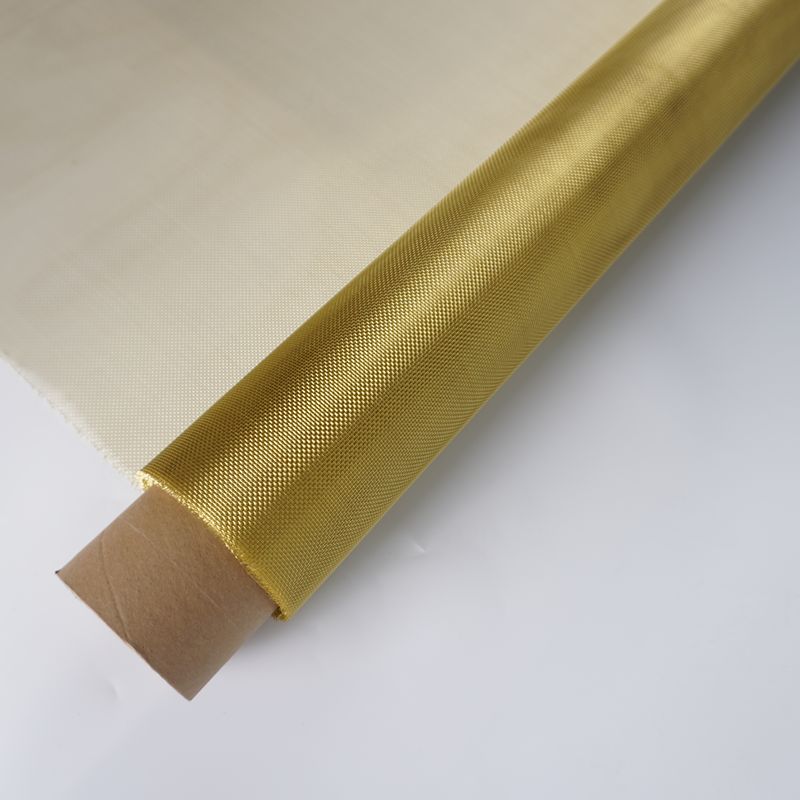
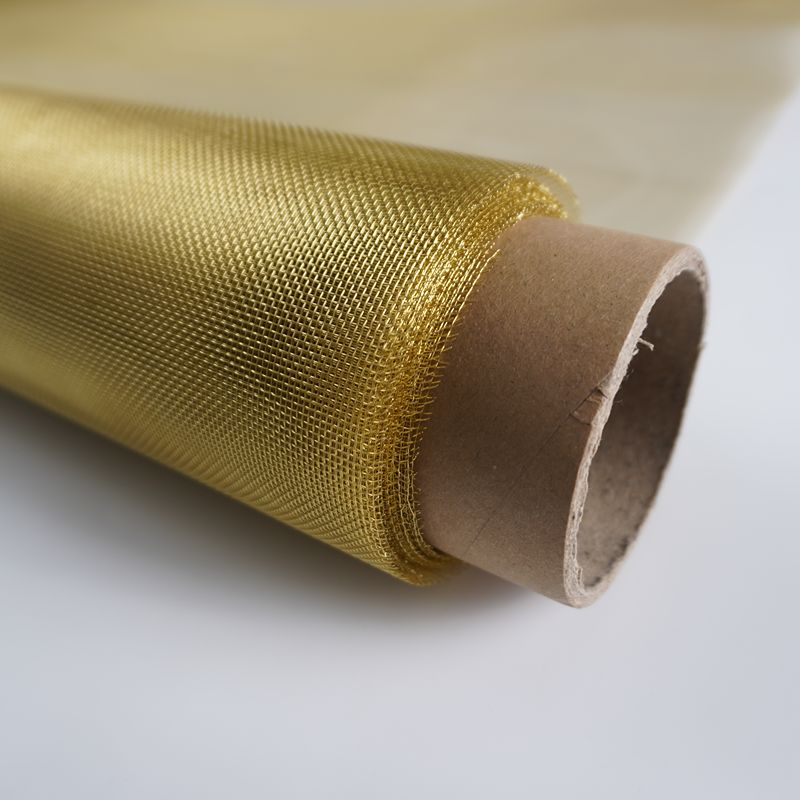
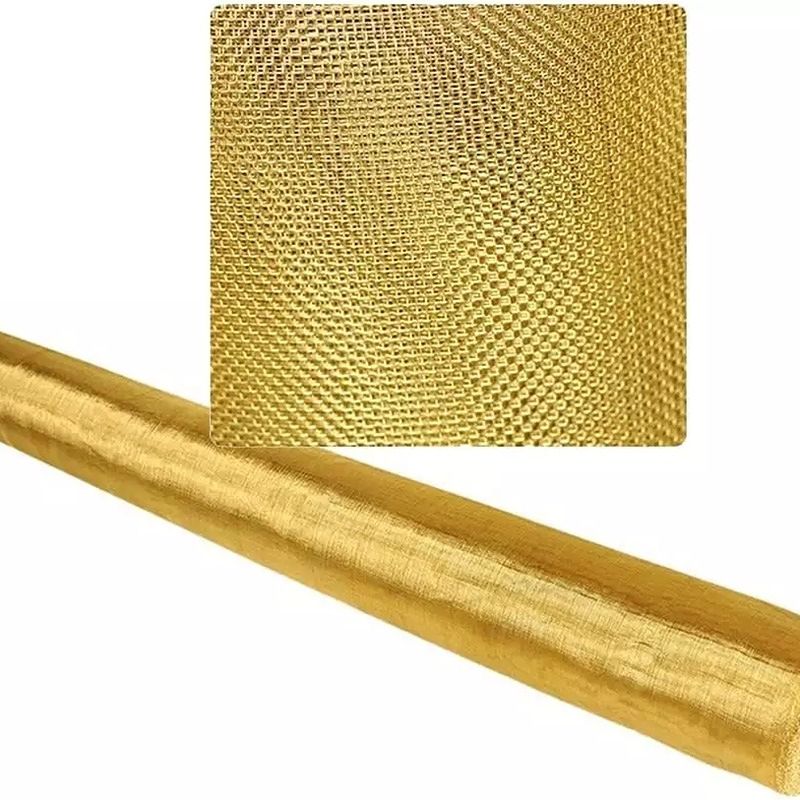
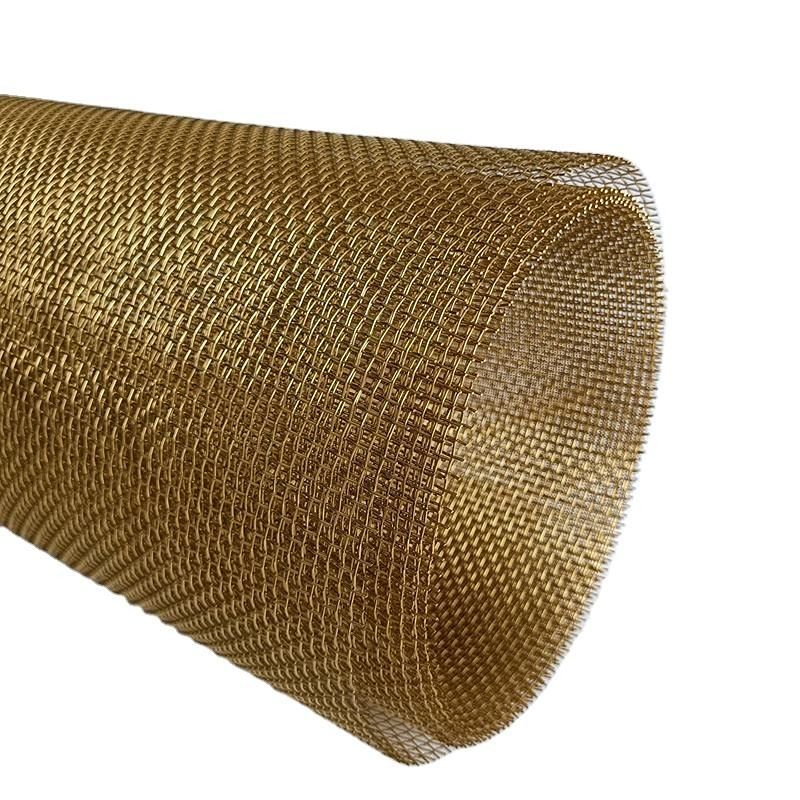
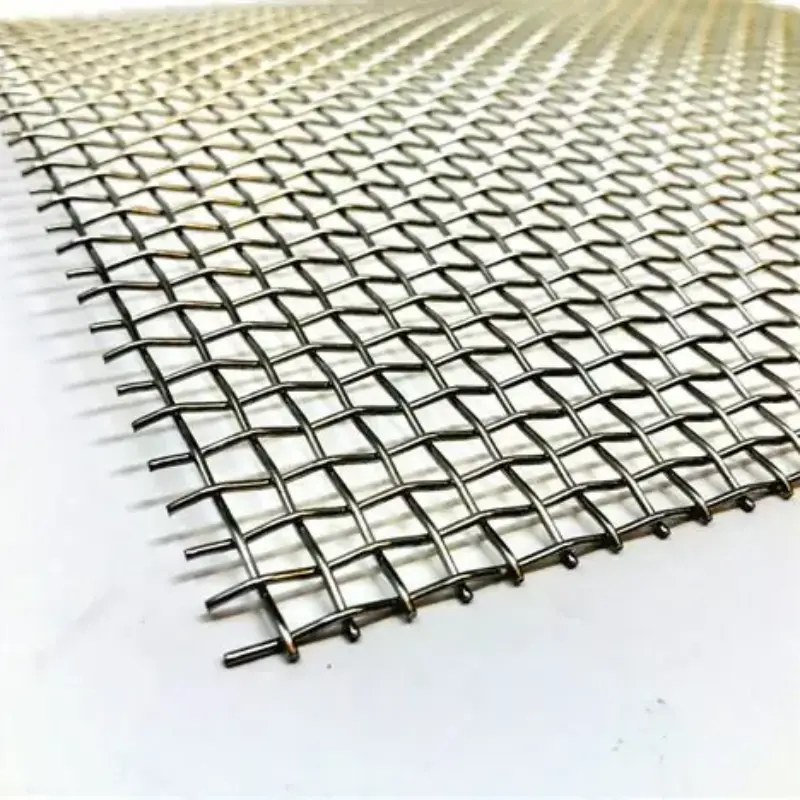
Copper-zinc woven wire cloth | H65 / H62 / H80 / C26000 | 6 to 200 mesh
1. Product Description
Brass wire mesh is a woven wire cloth manufactured from copper-zinc alloy wire. Bright-drawn brass wire is woven on the same shuttle and rapier looms used for stainless steel wire cloth, then slit, inspected and packed in rolls, sheets or cut panels. The material holds a distinct position in the copper-alloy family: it is harder, stiffer and considerably more abrasion resistant than pure copper mesh, it costs less than phosphor bronze, and its electrical and thermal conductivity is roughly ten times that of stainless steel.
Standard production uses H65 brass (65% copper, 35% zinc), which gives the best balance between the ductility needed for fine weaving and the strength needed in service. H62 is used for coarse and medium counts and for decorative work where cost and colour matter more than drawability; H80 gives a warmer tone and higher conductivity; 70/30 brass to UNS C26000 is available where a US grade is specified. Wire is supplied annealed or half-hard as standard, so that it crimps at the intersections without cracking and the cloth stays flat after weaving.
The mesh is defined by two independent numbers: mesh count (apertures per linear inch) and wire diameter. Together they fix the aperture, the open area and the mass per square metre — any three of these four values determine the fourth. A 100 mesh cloth can be woven with 0.10 mm wire to give 154 µm openings, or with 0.12 mm wire to give 134 µm openings. Mesh count on its own is therefore not a filtration specification, and both numbers should appear on every enquiry, drawing and order.
Plain weave is the standard construction and covers most of the range. Twill weave is used from about 100 mesh upwards, where the finer wire and closer pitch make a plain weave difficult to hold flat. Dutch weave — coarse warp, fine weft — is used for filter leaves, discs and cylinders that combine fine retention with resistance to differential pressure. Pre-crimped mesh is a separate product in which the wires are crimped before weaving to produce a rigid, self-supporting sheet for guards and infill panels.
2. Material and Alloy Grades
Brass for wire cloth is specified by copper content, because the copper/zinc ratio controls strength, ductility, colour and conductivity together. The four grades below cover virtually all industrial demand. All are single-phase alpha brasses, non-magnetic, and can be soft-soldered or brazed with standard consumables.
| Grade |
Cu (%) |
Zn (%) |
Equivalent designation |
Typical use |
| H65 |
65 |
35 |
CuZn35 / UNS C27000 |
Standard for filtration, sieving and shielding; best drawing performance in fine counts |
| H62 |
62 |
38 |
CuZn38 / UNS C27400 |
Coarse and medium mesh, decorative panels, cost-sensitive screening |
| H80 |
80 |
20 |
CuZn20 / UNS C24000 |
Higher conductivity and a warmer red-gold tone; instrument and decorative grilles |
| C26000 |
70 |
30 |
CuZn30 (70/30 cartridge brass) |
US-specified filter components; excellent cold formability, deep drawing and crimping |
Compositions to GB/T 5231, EN 12166 or ASTM B134 as agreed at order. Other copper-zinc grades and tempers are available on request.
3. Weave Styles and Edge Finish
The weave decides how the cloth behaves under load, how fine it can be woven and how it looks in service. Five constructions are produced; the choice should be made together with the mesh count, because a construction that suits 40 mesh is usually wrong at 300 mesh.
| Construction |
Description |
Typical range |
Where it is used |
| Plain weave |
One wire over, one under; square aperture, maximum open area for a given pitch |
6 – 200 mesh |
General filtration, sieving, EMI screens; lowest cost per square metre |
| Twill weave |
Two over, two under; diagonal pattern allows finer wire at the same count |
100 – 350 mesh |
Fine filtration; flatter and more dimensionally stable at fine counts |
| Plain Dutch weave |
Coarse warp, fine weft; triangular apertures, high strength across the warp |
40 – 200 mesh equivalent |
Filter leaves, discs and cylinders under differential pressure |
| Twill Dutch weave |
Fine wire in both directions; very fine retention with a dense surface |
200 – 400 mesh equivalent |
Fine fuel, hydraulic and instrument filtration |
| Pre-crimped |
Wires crimped before weaving; rigid, self-supporting sheet with large apertures |
1 – 12 mesh |
Guards, grilles, architectural infill, coarse screening |
Rolls are supplied with the woven selvage as standard: the edge is formed by the loom itself, so it cannot unravel and needs no finishing. Cut or rough edges are supplied where the cloth will be trimmed or clamped in a frame; a folded edge, a welded edge or a reinforcing band can be added for screens that are handled or cleaned frequently. Panels can be supplied square-cut to ±1 mm, deburred, or with corner radii on request.
4. Specifications
4.1 Standard mesh and wire combinations
The table gives the combinations held in regular production. Aperture, open area and mass are calculated from mesh count and wire diameter on the geometric basis set out in section 4.3, so the figures are internally consistent and can be used directly for sizing and freight estimates.
| Mesh / inch |
Wire dia. (mm) |
Wire dia. (in) |
Aperture (mm) |
Aperture (µm) |
Open area (%) |
Mass (kg/m²) |
| 1 |
2.95 |
0.1161 |
22.450 |
22,450 |
78.1 |
4.59 |
| 2 |
1.63 |
0.0642 |
11.070 |
11,070 |
76.0 |
2.80 |
| 4 |
1.22 |
0.0480 |
5.130 |
5,130 |
65.3 |
3.14 |
| 6 |
0.71 |
0.0280 |
3.523 |
3,523 |
69.3 |
1.60 |
| 8 |
0.61 |
0.0240 |
2.565 |
2,565 |
65.3 |
1.57 |
| 10 |
0.51 |
0.0201 |
2.030 |
2,030 |
63.9 |
1.37 |
| 12 |
0.46 |
0.0181 |
1.657 |
1,657 |
61.3 |
1.34 |
| 14 |
0.42 |
0.0165 |
1.394 |
1,394 |
59.1 |
1.30 |
| 16 |
0.35 |
0.0138 |
1.237 |
1,237 |
60.8 |
1.03 |
| 18 |
0.32 |
0.0126 |
1.091 |
1,091 |
59.8 |
0.97 |
| 20 |
0.32 |
0.0126 |
0.950 |
950 |
56.0 |
1.08 |
| 24 |
0.32 |
0.0126 |
0.738 |
738 |
48.7 |
1.30 |
| 30 |
0.25 |
0.0098 |
0.597 |
597 |
49.7 |
0.99 |
| 40 |
0.19 |
0.0075 |
0.445 |
445 |
49.1 |
0.76 |
| 50 |
0.17 |
0.0067 |
0.338 |
338 |
44.3 |
0.76 |
| 60 |
0.17 |
0.0067 |
0.253 |
253 |
35.8 |
0.91 |
| 80 |
0.12 |
0.0047 |
0.198 |
198 |
38.7 |
0.61 |
| 100 |
0.10 |
0.0039 |
0.154 |
154 |
36.8 |
0.53 |
| 120 |
0.08 |
0.0031 |
0.132 |
132 |
38.7 |
0.41 |
| 150 |
0.06 |
0.0024 |
0.109 |
109 |
41.7 |
0.28 |
| 180 |
0.05 |
0.0020 |
0.091 |
91 |
41.7 |
0.24 |
| 200 |
0.05 |
0.0020 |
0.077 |
77 |
36.8 |
0.26 |
Nominal values. Mass is calculated for straight wire at 8.53 g/cm³; add 3 – 6% for weave crimp when estimating shipping weight. Intermediate counts and wire diameters are woven to order.
4.2 General technical parameters
| Parameter |
Standard range |
| Material |
Brass wire H65 as standard; H62, H80 and C26000 (70/30) on request |
| Mesh count range |
6 – 200 mesh standard; 1 – 6 mesh and up to 350 mesh to order |
| Wire diameter range |
0.05 – 0.71 mm standard; 1.2 – 2.95 mm for coarse 1 – 4 mesh |
| Nominal aperture range |
0.077 mm (77 µm) to 22.4 mm |
| Weave |
Plain, twill, plain Dutch, twill Dutch, pre-crimped |
| Roll width |
1.0 / 1.22 / 1.5 m standard; up to 3.0 m on request |
| Roll length |
30 m (100 ft) standard; cut lengths to order |
| Sheet and panel size |
Up to 1.5 × 3.0 m, or cut to drawing |
| Mesh count tolerance |
± 3% for coarse and medium counts; ± 2 mesh for fine counts |
| Wire diameter tolerance |
± 0.005 mm; ± 0.003 mm for wire below 0.10 mm |
| Width tolerance |
± 5 mm on slit rolls; ± 1 mm on cut panels |
| Surface condition |
Bright, clean, oil-free; optional passivation or clear lacquer for appearance |
| Continuous service temperature |
− 40 to + 200 °C in clean dry air |
| Material certification |
EN 10204 Type 3.1 mill certificate on request |
4.3 Calculating aperture, open area and mass
Three relationships cover every square-weave combination and are the quickest check on a supplier's quotation. Mesh count M is apertures per inch; wire diameter d and aperture a are in millimetres.
Aperture a = 25.4 / M − d (mm)
Open area A = [ a / (a + d) ]² × 100 (%)
Mass m = 0.5275 × M × d² (kg/m², at 8.53 g/cm³)
Worked example — 100 × 100 mesh, 0.10 mm wire: aperture = 25.4 / 100 − 0.10 = 0.154 mm (154 µm); open area = (0.154 / 0.254)² × 100 = 36.8%; mass = 0.5275 × 100 × 0.10² = 0.53 kg/m². A 1.22 m × 30 m roll therefore weighs approximately 19.3 kg before packing.
4.4 Typical filtration ratings
Nominal aperture is a geometric opening, not a certified retention figure. The mapping below is the one used in practice for screen selection; where a guaranteed rating is required, ask for a bubble-point or glass-bead challenge test on the actual cloth.
| Mesh / inch |
Nominal aperture (µm) |
Indicative duty |
| 20 |
950 |
Coarse strainer; tank and sump screens |
| 40 |
445 |
Pre-filtration of paint, glaze and process water |
| 60 |
253 |
General filtration of oils and coolants |
| 80 |
198 |
Fine fuel and lubricant filtration |
| 100 |
154 |
Hydraulic return lines; fine chemical duty |
| 150 |
109 |
Instrument and burner nozzle protection |
| 200 |
77 |
Very fine filtration; sensor and analyser screens |
5. Physical and Mechanical Properties
Values are typical for wrought brass at 20 °C. They are given for engineering selection — for example, sizing a screen that must carry current, or deciding whether a hot-oil filter will retain its tension.
| Property |
H65 (CuZn35) |
H62 (CuZn38) |
C26000 (70/30) |
| Density (g/cm³) |
8.47 |
8.43 |
8.53 |
| Melting range (°C) |
900 – 940 |
900 – 935 |
916 – 954 |
| Electrical conductivity (% IACS) |
27 |
26 |
28 |
| Thermal conductivity (W/m·K) |
120 |
118 |
121 |
| Coefficient of thermal expansion (µm/m·K) |
20.0 |
20.5 |
20.0 |
| Modulus of elasticity (GPa) |
110 |
105 |
110 |
| Tensile strength, annealed wire (MPa) |
approx. 350 |
approx. 350 |
320 – 380 |
| Tensile strength, spring temper (MPa) |
approx. 850 |
approx. 830 |
860 – 900 |
| Magnetic behaviour |
Non-magnetic |
Non-magnetic |
Non-magnetic |
| Solderability / brazability |
Excellent |
Excellent |
Excellent |
Alloy property data for C26000 after the Copper Development Association; H65 and H62 values are typical mill data for the same family.
6. Key Features
-
- Strength with conductivity. Roughly 27% IACS and 120 W/m·K — about ten times the electrical and seven times the thermal conductivity of stainless steel — while remaining stiffer and far more abrasion resistant than copper.
- Non-magnetic and anti-sparking. Suitable for instrument shielding, explosive atmospheres and anywhere a steel screen would pick up or discharge.
- Workable with hand tools. Coarse mesh cuts with tin snips, 16 mesh and finer with ordinary scissors; the cloth bends, crimps and flanges without cracking, and solders with standard soft solder and a mild flux.
- Stable, uniform aperture. A woven metal screen holds its calibration in service, unlike a woven synthetic fabric that creeps, and it will not shed fibres into the product stream.
- Corrosion resistance for everyday duties. Atmosphere, fresh water, salt air, petrol, diesel, lubricating oils and mild alkalis are all handled without difficulty.
- Cleanable and re-usable. Back-flushing, ultrasonic cleaning and gentle brushing restore flow; there is no disposable element to replace.
- Warm gold appearance. The colour is intrinsic to the alloy and darkens to a stable brown patina; it is used uncoated in decorative and architectural work, or lacquered to hold the bright tone.
- 100% metal, 100% recyclable. No coating, adhesive or polymer component to degrade, and clean scrap carries a real recovery value.
- Heat number marked on every roll, with EN 10204 Type 3.1 certification available against the heat.
- Supplied finished. Rolls, cut panels, discs, rings and cylinders, with edge treatment and frames if required.
7. Applications
Brass mesh is chosen where conductivity, solderability or appearance matters, and where the duty is within the limits set out in section 9. The table gives the duties most often supplied.
| Industry / application |
Typical duty |
Why brass is chosen |
| Automotive fuel systems |
Tank strainers, carburettor and injector inlet screens, diesel pre-filters |
Resists petrol, diesel and ethanol blends; solders into brass housings; non-sparking |
| EMI / RFI shielding |
Faraday cages, shielded windows and vents, conductive gaskets |
27% IACS conductivity, solderable joints, non-magnetic |
| Powder, ceramic and glass |
Sieving and bolting screens for glaze, frit, pigment and abrasive powder |
Abrasion resistance, uniform aperture, survives vibration |
| Electroplating and anodising |
Anode baskets, cathode screens, solution filters |
Carries current, resists electrolyte, does not contaminate the bath |
| General filtration |
Lubricating oil, hydraulic and coolant filters; pump strainers |
Good resistance in oils and fuels; cleanable and re-usable |
| Marine and outdoor |
Insect screen, vent and louvre mesh, boat grilles |
Withstands salt atmosphere and salt spray |
| Architecture and interiors |
Cabinet and radiator grilles, room dividers, light diffusers |
Warm gold tone, fine even weave, ages to a stable patina |
| Instrument protection |
Acoustic grilles, sensor and microphone screens, flame arrestor mesh |
Fine aperture with high open area; non-magnetic |
| Arts and restoration |
Conservation mesh, bookbinding, sculpture armature |
Forms by hand, solders invisibly, takes patination |
8. Advantages
- Lower cost than copper or phosphor bronze for the same mesh count and wire diameter, with better strength than either at equivalent wire size.
- Ten times the conductivity of stainless steel, which makes brass the practical choice for screens that must carry current or transfer heat.
- Abrasion resistance well above copper, so a brass sieve outlasts a copper one in abrasive powder and glaze duty.
- No dezincification risk in normal atmospheric, fresh-water and fuel service, unlike high-zinc brasses used in plumbing.
- Excellent forming and joining behaviour: snip, bend, roll, crimp, soft-solder and braze without special tooling or heat treatment.
- Predictable geometry: aperture, open area and mass can be calculated and verified, so the screen can be sized rather than guessed.
- Non-magnetic and non-sparking, which rules out steel mesh for instrument and hazardous-area screens.
- Attractive as well as functional: the alloy colour is used deliberately in interior and product design, with a patina that is stable rather than corrosive.
The comparison below positions brass against the other woven media used for the same duties. It is a selection guide, not a ranking: each column wins on some duties and loses on others.
| Property |
Brass |
Phosphor bronze |
Copper |
Stainless steel 304 |
| Relative cost |
Low |
Moderate |
High |
Low – moderate |
| Tensile strength of wire |
Moderate |
High |
Low |
High |
| Abrasion resistance |
Good |
Very good |
Fair |
Excellent |
| Fatigue / spring properties |
Fair |
Excellent |
Poor |
Good |
| Electrical conductivity (% IACS) |
27 |
15 |
100 |
2.4 |
| Thermal conductivity (W/m·K) |
120 |
70 |
390 |
16 |
| Seawater resistance |
Fair |
Good |
Fair |
Very good (316L) |
| Max. continuous service temp. (°C) |
200 |
200 |
200 |
400 – 600 |
| Solderability |
Excellent |
Excellent |
Excellent |
Poor |
| Non-magnetic |
Yes |
Yes |
Yes |
No (slightly, when cold worked) |
Indicative comparison for selection only; actual performance depends on mesh count, wire diameter, temper and service conditions.
9. Selection Notes and Limitations
These points decide more failed installations than any other factor, and are stated here so that the material is not applied outside its range.
- Ammonia and amines. Ammonia, ammonium hydroxide, amine-based corrosion inhibitors and moist sulfur compounds attack brass and can cause dezincification and stress-corrosion cracking. Specify phosphor bronze or stainless steel for these duties.
- Acids and oxidising media. Strong mineral acids and oxidising solutions are not compatible; check the specific medium before ordering.
- Support fine cloth. Cloth with wire of 0.10 mm or less needs a backing layer, a perforated plate or a reduced differential pressure. An unsupported span sags, and the aperture distorts before the cloth actually fails.
- Tarnish is normal. Colour moves from bright gold to brown. Filtration is unaffected, but contact resistance rises and soldering becomes harder. Specify passivation or clear lacquer where appearance or electrical contact matters.
- Galvanic contact. In wet assemblies, brass against aluminium, zinc or mild steel forms a galvanic couple. Isolate with washers, or specify a compatible frame material.
- Not a certified rating. The nominal aperture is geometric. Absolute retention depends on particle shape, weave and pressure; request a bubble-point or bead test if the rating is part of acceptance.
- Temperature limit. Do not soft-solder a filter that will operate above about 150 °C, and do not exceed 200 °C continuous in air; above that the wire anneals and the cloth loses tension.
10 Quality Control, Packing and Documentation
Each production lot is checked against the agreed specification at four points:
- Incoming wire — chemical composition by spectrometer, diameter by micrometer, surface and temper.
- Weaving — warp and weft count per 100 mm at three positions across the width; tension and reed marks.
- Inspection — optical aperture measurement on a video measuring system, wire diameter, width and length, visual check for broken wires, loose ends and oil stains.
- Final — roll mass against the calculated value, edge condition, core and wrapping integrity.
Rolls are wound on a cardboard core, interleaved with moisture-proof paper and wrapped in PE film, then packed in wooden crates or on pallets; desiccant is added for sea freight. Each roll is marked with grade, mesh count, wire diameter, width, length, heat number and roll number. Documentation includes the packing list, material certificate to EN 10204 Type 3.1 where requested, and a RoHS / REACH declaration.
11. Ordering Information
A quotation can only be firm when the following are fixed. Where a drawing exists, it takes precedence over this list.
- Alloy and temper — H65, H62, H80 or C26000; annealed or half-hard.
- Mesh count and wire diameter — or the required aperture in millimetres or microns.
- Weave — plain, twill, Dutch or pre-crimped.
- Form and size — roll width and length, or panel / disc dimensions with tolerances.
- Edge treatment — woven selvage, cut edge, folded, welded or banded.
- Quantity — rolls, square metres or pieces, and the annual requirement if this is a repeat item.
- Service conditions — medium, temperature, differential pressure and cleaning method.
- Acceptance — aperture tolerance, inspection records, material certificate, third-party inspection.
- Packing and marking — export crate, pallet, desiccant, customer labels.
Example enquiry: “Please quote plain-weave brass wire mesh, H65, 100 × 100 mesh, 0.10 mm wire, nominal aperture 0.154 mm, 1.22 m wide × 30 m roll, 2 rolls. Please confirm aperture tolerance, edge type, temper, mass per roll and availability of an EN 10204 Type 3.1 certificate.”
Supplier and Contact
Anping County Bolin Metal Wire Mesh Co., Ltd.
Address: NO15, Building 1, B Zone, Wire Mesh World, Anping County, Hengshui City, Hebei Province, China 053600
Tel: +86-318-5280116 Fax: +86-318-7020860 Mobile / WhatsApp: +86-170 6528 1888
E-mail: sales@bolinwiremesh.com Web: www.bolinmetalmesh.com | www.metalmeshfilters.com
Established 2004 | ISO 9001:2015 | Woven wire cloth manufacturing for over 20 years
Beyond what you ask. Ahead of what you expect.