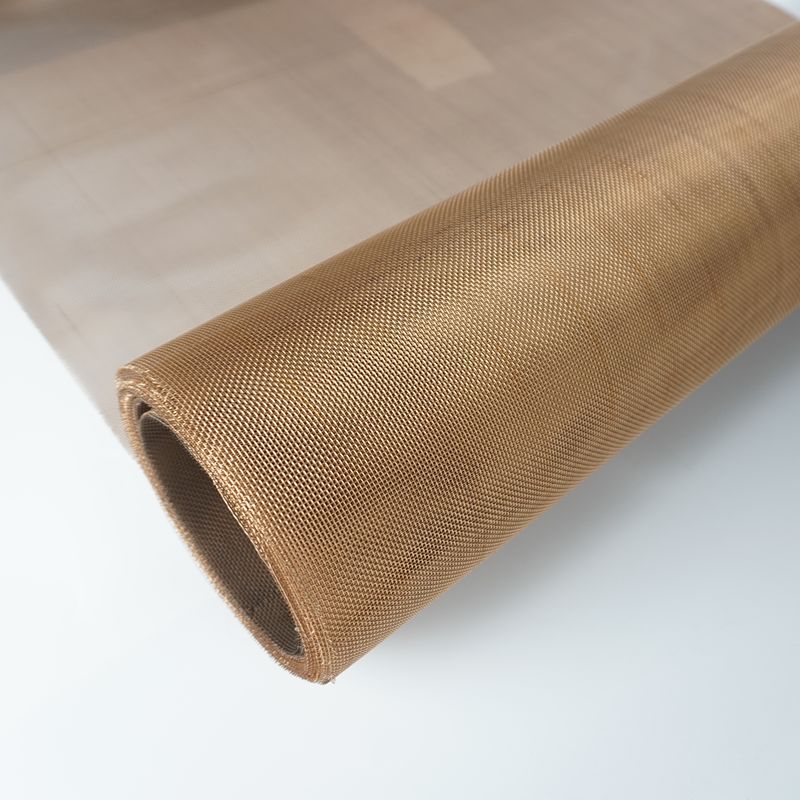
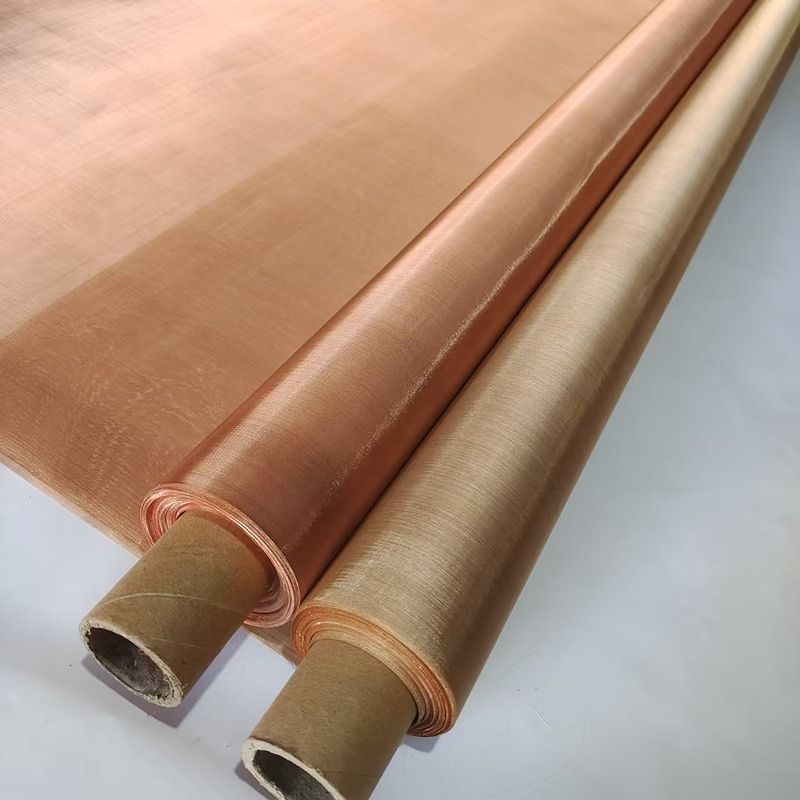
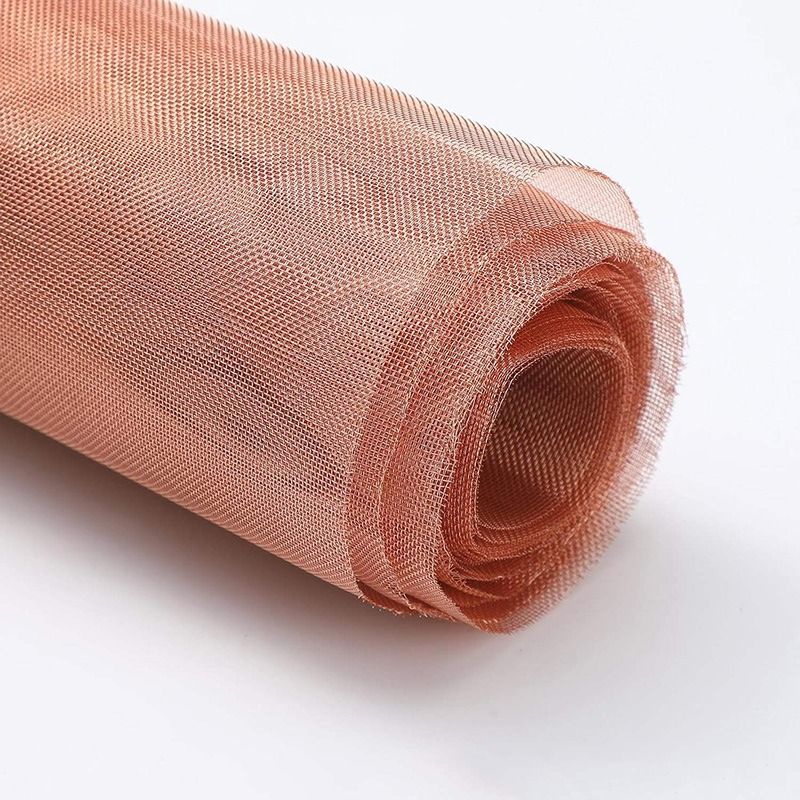
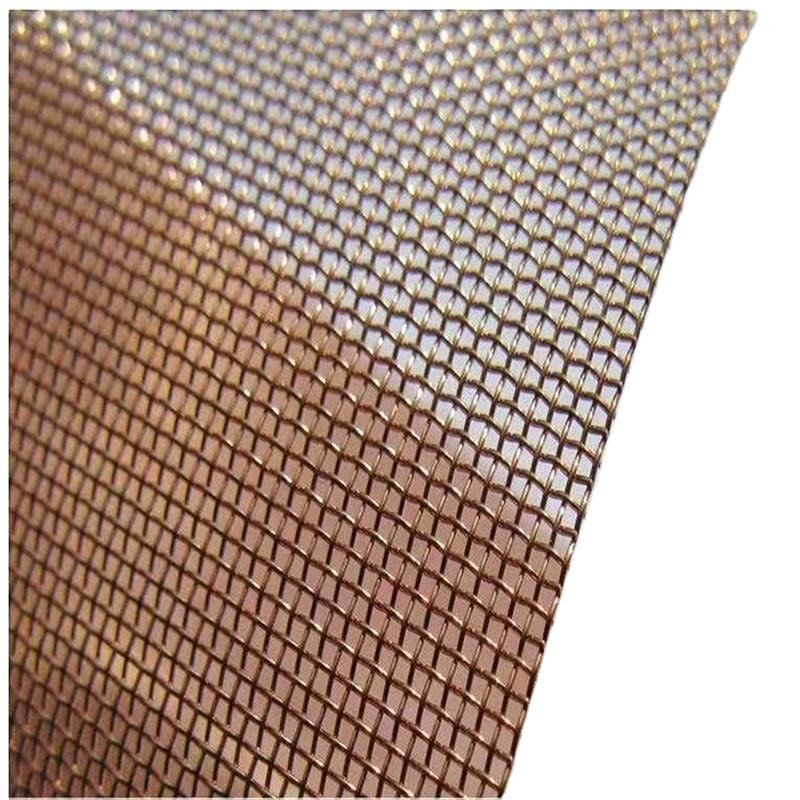
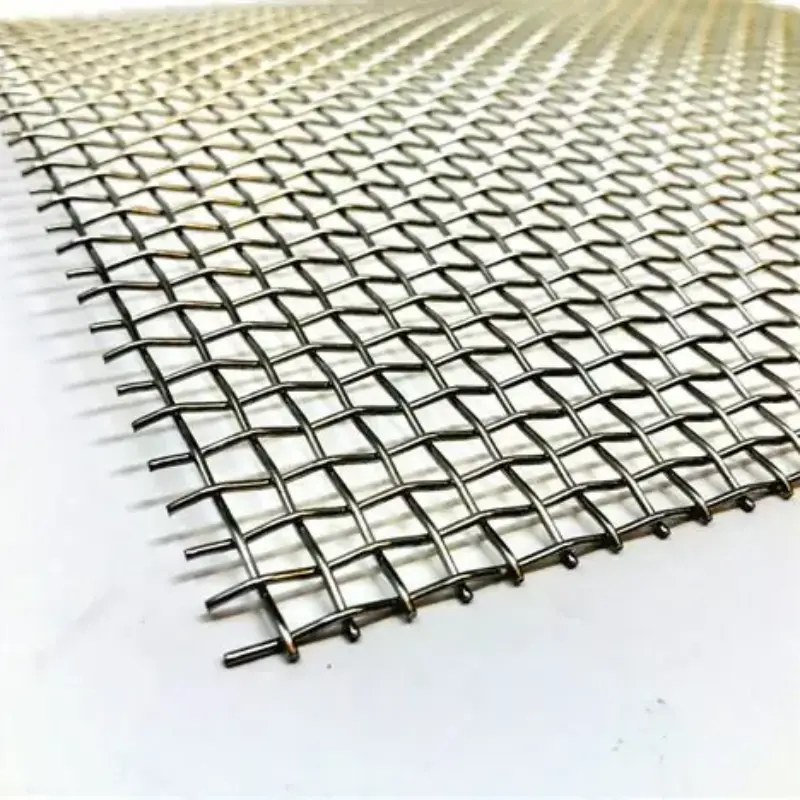
Copper-tin-phosphorus woven wire cloth | C51000 / C52100 / QSn6.5-0.1 | 6 to 400 mesh
1. Product Description
Phosphor bronze wire mesh is a woven wire cloth made from copper-tin-phosphorus alloy wire, also supplied and specified as phosphor bronze wire cloth or bronze filter mesh. Tin raises the strength, hardness and fatigue resistance of copper without destroying its conductivity; phosphorus, added as a deoxidiser, cleans the melt and improves fluidity, so the alloy can be drawn to the very fine wire needed for 300 and 400 mesh cloth without embrittlement. The result is the toughest of the copper-alloy wire cloths and the one chosen where a brass or copper screen would fatigue, stretch or corrode.
Because the alloy contains no zinc, phosphor bronze is not subject to the dezincification that limits brass in aggressive water, and it resists stress-corrosion cracking far better. Its corrosion behaviour in sea water, in pure steam and in marine and industrial atmospheres is rated excellent, and it holds those ratings at the thin wire sections used in fine cloth, where a small amount of metal loss matters most.
Three grades cover the market. C51000, the 5% tin grade known commercially as phosphor bronze “5% A”, is the standard weaving alloy and is used for the great majority of filtration and shielding cloth. C52100, the 8% tin grade (“8% C”), gives roughly 20–25% more tensile strength and better wear resistance for abrasive or heavily vibrating duty. QSn6.5-0.1 is the Chinese-standard grade that sits between the two and is the one most often quoted for export orders from China.
As with every woven cloth, mesh count alone does not define the product: the wire diameter must be quoted with it. A 200 mesh cloth woven with 0.051 mm wire has 76 µm openings, while the same count with 0.04 mm wire has 87 µm openings and 31% more open area. Aperture, open area and mass per square metre follow from those two numbers and are tabulated in section.
2. Material and Alloy Grades
Phosphor bronze for wire cloth is specified by tin content first and phosphorus second. Tin is the strengthening element; phosphorus is kept in the range 0.03–0.35% — enough to deoxidise the melt and improve wear resistance, not enough to make the wire difficult to draw. All grades are single-phase, non-magnetic, and solder and braze with standard consumables.
| Grade |
Cu (%) |
Sn (%) |
P (%) |
Standard |
Typical use |
| C51000 (“5% A”) |
Rem. ≈ 94.8 |
4.2 – 5.8 |
0.03 – 0.35 |
ASTM B159 / UNS |
Standard weaving alloy: fine filtration, marine, EMI shielding, instrument screens |
| C52100 (“8% C”) |
Rem. ≈ 91.8 |
7.0 – 9.0 |
0.03 – 0.35 |
ASTM B159 / UNS |
Higher strength and wear resistance; abrasive duty, heavy vibration, spring temper cloth |
| QSn6.5-0.1 |
Remainder |
6.0 – 7.0 |
0.10 – 0.25 |
GB/T 5231 |
Chinese-standard grade between the two; the grade normally quoted for export orders |
Composition ranges as published for wrought phosphor bronze. Certificates to EN 10204 Type 3.1 are issued against the heat actually used.
3. Weave Styles and Edge Finish
Fine phosphor bronze is normally woven plain up to about 200 mesh and in twill above that, because the thin wire and close pitch of a fine count will not sit flat in a plain weave. Dutch weaves are used where the cloth has to retain a fine particle while carrying a pressure differential — the classic bronze filter leaf, disc and cylinder.
| Construction |
Description |
Typical range |
Where it is used |
| Plain weave |
One wire over, one under; square aperture, highest open area for a given pitch |
6 – 200 mesh |
General filtration and sieving; the most economical construction |
| Twill weave |
Two over, two under; permits finer wire and a denser cloth at the same count |
150 – 400 mesh |
Fine fuel, hydraulic and chemical filtration; flatter, more stable cloth |
| Plain Dutch weave |
Coarse warp, fine weft; triangular apertures with high warp strength |
60 – 200 mesh equivalent |
Filter leaves, discs and cylinders under pressure |
| Twill Dutch weave |
Fine wire both directions; dense surface, very fine retention |
200 – 400 mesh equivalent |
High-precision filtration, sensor and analyser protection |
Rolls carry the woven selvage as standard, so the edge cannot unravel. Cut edges are supplied for cloth that will be trimmed or clamped; folded, welded or banded edges are available for screens that are cleaned and re-fitted regularly. Because phosphor bronze work-hardens, cut edges should be deburred before the cloth is handled — a burr on 0.05 mm wire will start a tear.
4. Specifications
4.1 Standard mesh and wire combinations
The table covers the combinations held in regular production, from 6 mesh coarse screen to 400 mesh analytical cloth. Aperture, open area and mass are calculated on the geometric basis given in section 4.3 and are therefore consistent with each other.
| Mesh / inch |
Wire dia. (mm) |
Wire dia. (in) |
Aperture (mm) |
Aperture (µm) |
Open area (%) |
Mass (kg/m²) |
| 6 |
0.711 |
0.0280 |
3.522 |
3,522.3 |
69.2 |
1.66 |
| 8 |
0.610 |
0.0240 |
2.565 |
2,565.0 |
65.3 |
1.63 |
| 10 |
0.508 |
0.0200 |
2.032 |
2,032.0 |
64.0 |
1.41 |
| 12 |
0.457 |
0.0180 |
1.660 |
1,659.7 |
61.5 |
1.37 |
| 16 |
0.345 |
0.0136 |
1.242 |
1,242.5 |
61.3 |
1.04 |
| 20 |
0.315 |
0.0124 |
0.955 |
955.0 |
56.5 |
1.09 |
| 24 |
0.315 |
0.0124 |
0.743 |
743.3 |
49.3 |
1.30 |
| 30 |
0.274 |
0.0108 |
0.573 |
572.7 |
45.7 |
1.23 |
| 40 |
0.193 |
0.0076 |
0.442 |
442.0 |
48.5 |
0.82 |
| 50 |
0.173 |
0.0068 |
0.335 |
335.0 |
43.5 |
0.82 |
| 60 |
0.152 |
0.0060 |
0.271 |
271.3 |
41.1 |
0.76 |
| 80 |
0.122 |
0.0048 |
0.196 |
195.5 |
37.9 |
0.65 |
| 100 |
0.102 |
0.0040 |
0.152 |
152.0 |
35.8 |
0.57 |
| 120 |
0.081 |
0.0032 |
0.131 |
130.7 |
38.1 |
0.43 |
| 150 |
0.061 |
0.0024 |
0.108 |
108.3 |
40.9 |
0.31 |
| 180 |
0.051 |
0.0020 |
0.090 |
90.1 |
40.8 |
0.26 |
| 200 |
0.051 |
0.0020 |
0.076 |
76.0 |
35.8 |
0.29 |
| 250 |
0.040 |
0.0016 |
0.062 |
61.6 |
36.8 |
0.22 |
| 300 |
0.035 |
0.0014 |
0.050 |
49.7 |
34.4 |
0.20 |
| 325 |
0.035 |
0.0014 |
0.043 |
43.2 |
30.5 |
0.22 |
| 400 |
0.025 |
0.0010 |
0.038 |
38.5 |
36.8 |
0.14 |
Nominal values, calculated at 8.86 g/cm³ for C51000. Add 3 – 6% for weave crimp when estimating shipping weight. Intermediate counts and non-standard wire diameters are woven to order.
4.2 General technical parameters
| Parameter |
Standard range |
| Material |
Phosphor bronze wire C51000 as standard; C52100 and QSn6.5-0.1 on request |
| Mesh count range |
6 – 400 mesh; 1 – 6 mesh coarse screen to order |
| Wire diameter range |
0.025 – 0.711 mm |
| Nominal aperture range |
0.038 mm (38 µm) to 3.52 mm |
| Weave |
Plain, twill, plain Dutch, twill Dutch |
| Temper |
Annealed (O) as standard for weaving; half-hard (H02) and spring (H08) on request |
| Roll width |
1.0 / 1.22 / 1.5 m standard; up to 3.0 m on request |
| Roll length |
30 m (100 ft) standard; cut lengths to order |
| Sheet and panel size |
Up to 1.5 × 3.0 m, or cut to drawing |
| Mesh count tolerance |
± 3% for coarse and medium counts; ± 2 mesh for fine counts |
| Wire diameter tolerance |
± 0.003 mm below 0.10 mm; ± 0.005 mm above |
| Width tolerance |
± 5 mm on slit rolls; ± 1 mm on cut panels |
| Surface condition |
Bright, clean, oil-free; optional anti-tarnish wrap |
| Continuous service temperature |
− 40 to + 200 °C in clean dry air |
| Material certification |
EN 10204 Type 3.1 mill certificate on request |
4.3 Calculating aperture, open area and mass
The three relationships below apply to every square-weave combination and are the fastest check on a quotation. Mesh count M is apertures per inch; wire diameter d and aperture a are in millimetres.
Aperture a = 25.4 / M − d (mm)
Open area A = [ a / (a + d) ]² × 100 (%)
Mass m = 0.5480 × M × d² (kg/m², at 8.86 g/cm³)
Worked example — 200 × 200 mesh, 0.051 mm wire: aperture = 25.4 / 200 − 0.051 = 0.076 mm (76 µm); open area = (0.076 / 0.127)² × 100 = 35.8%; mass = 0.5480 × 200 × 0.051² = 0.29 kg/m². A 1.22 m × 30 m roll therefore weighs approximately 10.4 kg before packing.
4.4 Typical filtration ratings
Nominal aperture is a geometric opening and not a certified retention figure; for a guaranteed rating, ask for a bubble-point or glass-bead challenge test on the cloth actually supplied.
| Mesh / inch |
Nominal aperture (µm) |
Indicative duty |
| 60 |
271.3 |
Coarse hydraulic and fuel strainers |
| 80 |
195.5 |
General oil, fuel and coolant filtration |
| 100 |
152.0 |
Fine fuel and hydraulic filtration |
| 150 |
108.3 |
Chemical and instrument filtration |
| 200 |
76.0 |
Very fine filtration; sensor and probe protection |
| 325 |
43.2 |
Fine chemical, dye and ink filtration |
| 400 |
38.5 |
Finest woven grade; analytical and high-purity duty |
5. Physical and Mechanical Properties
Values are typical for wrought phosphor bronze at 20 °C. The two columns correspond to the 5% and 8% tin grades; where a property is not listed for QSn6.5-0.1, the C51000 figure is the closer guide.
| Property |
C51000 (5% A) |
C52100 (8% C) |
| Density (g/cm³) |
8.86 |
8.80 |
| Melting range (°C) |
954 – 1049 |
882 – 1027 |
| Electrical conductivity (% IACS) |
15 |
13 |
| Thermal conductivity (W/m·K) |
69 |
62 |
| Coefficient of thermal expansion (µm/m·K) |
17.8 |
18.2 |
| Modulus of elasticity (GPa) |
110 |
110 |
| Tensile strength, annealed wire (MPa) |
320 – 450 |
400 – 500 |
| Tensile strength, half-hard wire (MPa) |
approx. 580 |
approx. 720 |
| Tensile strength, spring temper (MPa) |
760 – 950 |
900 – 965 |
| Magnetic behaviour |
Non-magnetic |
Non-magnetic |
| Solderability / brazability |
Excellent |
Excellent |
Alloy data after the Copper Development Association (C51000, C52100). QSn6.5-0.1 to GB/T 5231 behaves between the two columns.
6. Key Features
-
- The highest fatigue strength of the copper-alloy cloths. A phosphor bronze screen keeps its tension under pulsation and vibration — compressor, engine and hydraulic duty — where brass work-hardens and cracks and copper simply stretches.
- No zinc, so no dezincification. The failure mode that limits brass in aggressive water and warm electrolytes does not apply, and stress-corrosion cracking resistance is substantially better.
- Rated excellent in sea water and pure steam. Published corrosion data for C51000 gives an excellent rating in sea water, marine atmosphere and pure steam — unusual for a material that also conducts electricity.
- Fine mesh with usable strength. Cloth is woven to 400 mesh (38 µm) with 0.025 mm wire, and it still handles and cleans without the fragility of pure copper at the same count.
- Good conductivity retained. 15% IACS and 69 W/m·K — lower than copper or brass, but six times the electrical and four times the thermal conductivity of stainless steel.
- Non-magnetic and anti-sparking. Suitable for instrument shielding, mine and hazardous-area equipment, and anywhere a steel screen would pick up or discharge.
- Joins without special process. Soft solder, silver solder and brazing all work; the cloth can be bonded into brass or bronze housings to make a finished element.
- Stable aperture and cleanable. A woven alloy screen holds its calibration, back-flushes, and can be ultrasonically cleaned and re-used; nothing sheds into the product stream.
- Supplied finished. Rolls, cut panels, discs, rings, pleated packs and cylinders, with edge treatment and support layers where required.
- Heat number marked on every roll, with EN 10204 Type 3.1 certification available against the heat.
7. Applications
Phosphor bronze is chosen where a fine aperture must survive vibration, salt water, or a medium that would attack brass — and where stainless steel is either too coarse a filter medium at the same thickness, or unacceptable for conductivity or galling reasons.
| Industry / application |
Typical duty |
Why phosphor bronze |
| Automotive and diesel fuel |
Injector inlet screens, fuel pump strainers, carburettor filters |
Fine aperture with fatigue strength; unaffected by petrol, diesel and biodiesel |
| Hydraulic and lubrication |
Return-line and suction strainers, valve and actuator screens |
Holds tension under pressure pulsation; tolerates hot oil |
| Marine and offshore |
Sea-water strainers, engine and gearbox filters, deck drainage screens |
Excellent sea-water rating; no dezincification |
| Chemical and petrochemical |
Catalyst recovery, solvent and amine-free process filtration |
Resists dilute acids, alkalis and hydrocarbons; solderable into housings |
| Sintered bronze filter media |
Support and drainage layers for sintered powder elements |
Metallurgically compatible; bonds during sintering |
| Instrument and sensor |
Probe protection, analyser filters, acoustic and microphone grilles |
Fine aperture, high open area, non-magnetic |
| EMI / RFI shielding |
Shielding gaskets, connector and display windows |
Conductive, solderable, non-magnetic |
| Glass, ceramic and abrasives |
Sieving and bolting screens for frit, glaze and pigment |
Wear resistance and strength at fine counts |
| Flame and spark arrestors |
Arrestor mesh in fuel and gas handling equipment |
Fine mesh that will not corrode through in damp service |
8. Advantages
- Fatigue life, not just tensile strength. Repeated pressure cycles are what destroy filter screens; phosphor bronze has the highest fatigue rating of the copper-alloy cloths and the spring temper to use it.
- Corrosion performance that suits marine and steam duty, without the weight, galling and conductivity penalties of stainless steel.
- No dezincification and far better stress-corrosion resistance than brass, which removes the two mechanisms that most often cause unexpected failures in copper-alloy screens.
- Fine apertures with practical strength: 38 µm at 400 mesh, still cleanable and re-usable.
- Conductivity retained: 15% IACS and 69 W/m·K, so the same cloth can filter and carry current or heat.
- Non-magnetic and non-sparking, which matters in instrument, mining and hazardous-area applications.
- Joins and forms conventionally: solder, braze, crimp, roll and pleat with standard tooling.
- Long service life and recovery value: an all-metal element that is cleaned rather than replaced, and recycled as bronze scrap at the end of its life.
The comparison below positions phosphor bronze against the other woven media used for the same duties. It is a selection guide, not a ranking: each material wins on some duties and loses on others.
| Property |
Phosphor bronze |
Brass |
Copper |
Stainless steel 316L |
| Relative cost |
Moderate |
Low |
High |
Low – moderate |
| Tensile strength of wire |
High |
Moderate |
Low |
High |
| Fatigue / spring properties |
Excellent |
Fair |
Poor |
Good |
| Abrasion resistance |
Very good |
Good |
Fair |
Excellent |
| Electrical conductivity (% IACS) |
15 |
27 |
100 |
2.3 |
| Thermal conductivity (W/m·K) |
69 |
120 |
390 |
16 |
| Sea-water resistance |
Excellent |
Fair |
Fair |
Excellent |
| Dezincification risk |
None |
Present |
None |
None |
| Max. continuous service temp. (°C) |
200 |
200 |
200 |
400 – 600 |
| Solderability |
Excellent |
Excellent |
Excellent |
Poor |
| Non-magnetic |
Yes |
Yes |
Yes |
Yes |
Indicative comparison for selection only; actual performance depends on mesh count, wire diameter, temper and service conditions.
9. Corrosion Behaviour and Selection Notes
Phosphor bronze is a wide-spectrum material but not a universal one. Published corrosion ratings for C51000 are summarised below, followed by the application limits that matter in practice.
| Medium / environment |
Rating |
Notes |
| Sea water |
Excellent |
Erosion-corrosion possible at high flow velocity |
| Marine and industrial atmosphere |
Excellent |
Protective green patina forms; hydrogen sulfide causes rapid tarnishing |
| Pure steam |
Excellent |
Carbon dioxide, dissolved oxygen or ammonia increase attack |
| Gasoline, diesel, kerosene, fuel oil |
Excellent |
Contaminants such as water, sulfides and acids raise corrosion |
| Sodium and potassium hydroxide |
Good |
Attack increases with temperature and oxidisers |
| Dilute hydrochloric acid |
Fair |
Cold, dilute and oxidiser-free only |
| Ammonia and ammonium hydroxide |
Poor |
Soluble complex ion forms — avoid |
| Moist hydrogen sulfide |
Poor |
Rapid tarnish and attack |
Ratings after Copper Development Association corrosion data for C51000; confirm against the actual medium, concentration and temperature before ordering.
9.1 Limits to observe
- Ammonia, amines and moist sulfides. Ammonia, ammonium compounds, amine-based inhibitors and moist hydrogen sulfide attack the alloy. Specify stainless steel or Monel for these duties.
- Support fine cloth. Below about 0.06 mm wire, the cloth needs a backing layer, a perforated plate or a reduced differential pressure; an unsupported span deforms and the aperture drifts.
- Do not over-clean. Back-flush and ultrasonic cleaning are appropriate; wire brushing and abrasive pads wear the wire and open the aperture.
- Work-hardening at cut edges. Deburr cut panels before fitting; a burr on fine wire initiates a tear under vibration.
- Galvanic contact. In wet assemblies, isolate the bronze from aluminium, zinc and mild steel with washers or a compatible frame.
- Temperature limit. Do not soft-solder an element that will run above about 150 °C; do not exceed 200 °C continuous in air, where the wire anneals and the cloth loses tension.
- Nominal is not absolute. The tabulated aperture is geometric. Where the retention figure is part of acceptance, specify the test method and the acceptance value.
10. Quality Control, Packing and Documentation
Each production lot is checked against the agreed specification at four points:
- Incoming wire — composition by spectrometer, diameter by micrometer, surface and temper.
- Weaving — warp and weft count per 100 mm at three positions across the width; tension and reed marks.
- Inspection — optical aperture measurement on a video measuring system, wire diameter, width and length, visual check for broken wires, loose ends and edge damage.
- Final — roll mass against the calculated value, edge condition, core and wrapping integrity.
Rolls are wound on a cardboard core, interleaved with moisture-proof paper and wrapped in PE film, then packed in wooden crates or on pallets; desiccant is added for sea freight, together with anti-tarnish paper where the cloth will be stored for long periods. Each roll is marked with grade, mesh count, wire diameter, width, length, heat number and roll number. Documentation includes the packing list, material certificate to EN 10204 Type 3.1 where requested, and a RoHS / REACH declaration.
11. Ordering Information
A quotation can only be firm when the following are fixed. Where a drawing exists, it takes precedence over this list.
- Alloy and temper — C51000, C52100 or QSn6.5-0.1; annealed, half-hard or spring.
- Mesh count and wire diameter — or the required aperture in millimetres or microns.
- Weave — plain, twill, plain Dutch or twill Dutch.
- Form and size — roll width and length, or panel / disc dimensions with tolerances.
- Edge treatment — woven selvage, cut edge, folded, welded or banded.
- Quantity — rolls, square metres or pieces, and the annual requirement if this is a repeat item.
- Service conditions — medium and concentration, temperature, differential pressure, cleaning method.
- Acceptance — aperture tolerance, filtration test, inspection records, material certificate, third-party inspection.
- Packing and marking — export crate, pallet, desiccant, anti-tarnish wrap, customer labels.
| Example enquiry: “Please quote plain-weave phosphor bronze wire mesh, C51000, 200 × 200 mesh, 0.051 mm wire, nominal aperture 0.076 mm, 1.22 m wide × 30 m roll, 1 roll, anti-tarnish wrap. Please confirm aperture tolerance, edge type, temper and availability of an EN 10204 Type 3.1 certificate.” |
Supplier and Contact
Anping County Bolin Metal Wire Mesh Co., Ltd.
Address: NO15, Building 1, B Zone, Wire Mesh World, Anping County, Hengshui City, Hebei Province, China 053600
Tel: +86-318-5280116 Fax: +86-318-7020860 Mobile / WhatsApp: +86-170 6528 1888
E-mail: sales@bolinwiremesh.com Web: www.bolinmetalmesh.com | www.metalmeshfilters.com
Established 2004 | ISO 9001:2015 | Woven wire cloth manufacturing for over 20 years
Beyond what you ask. Ahead of what you expect.