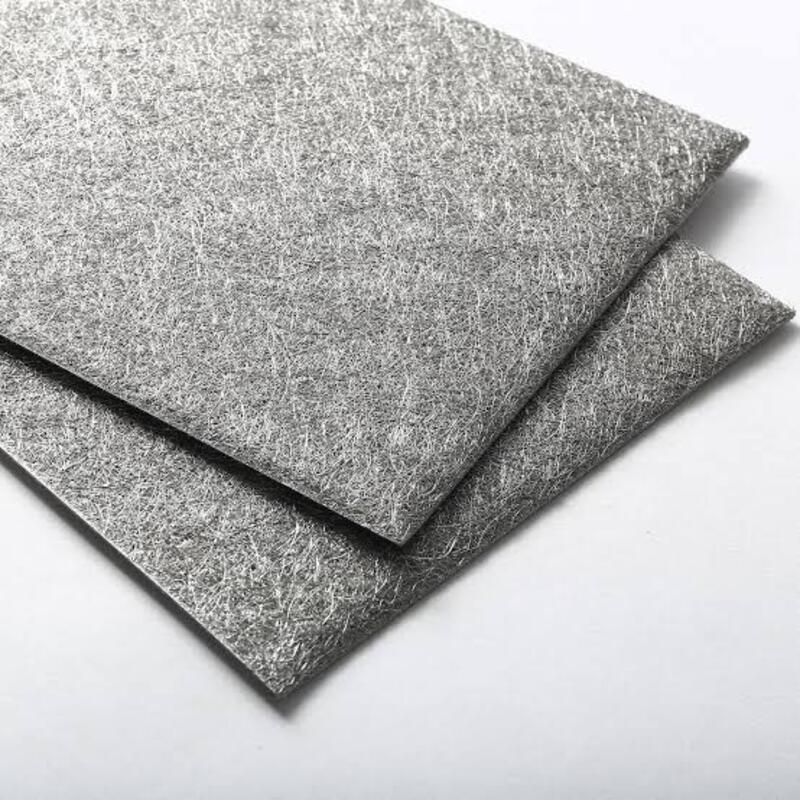
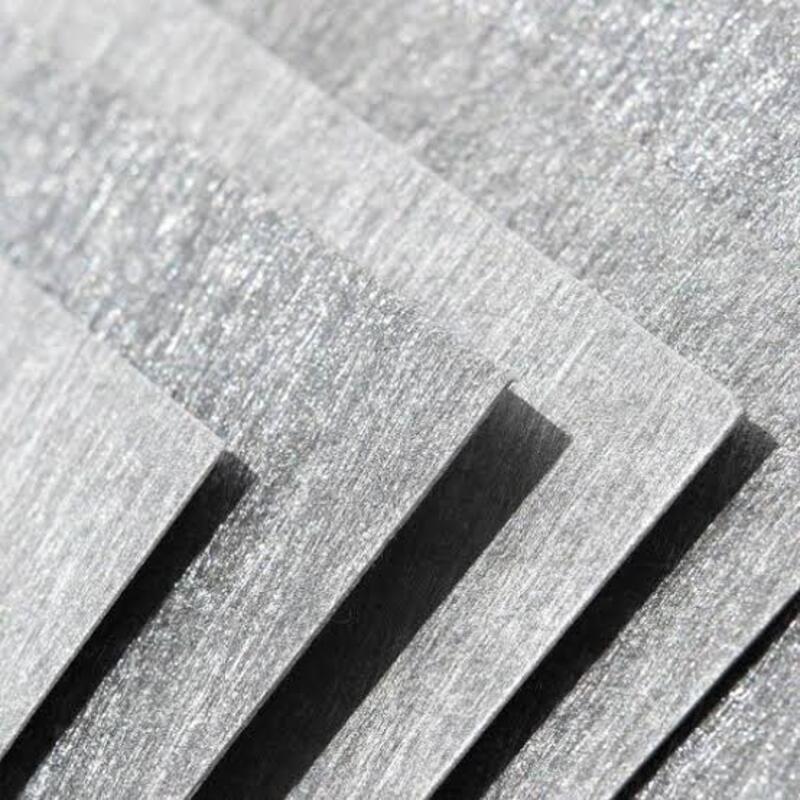
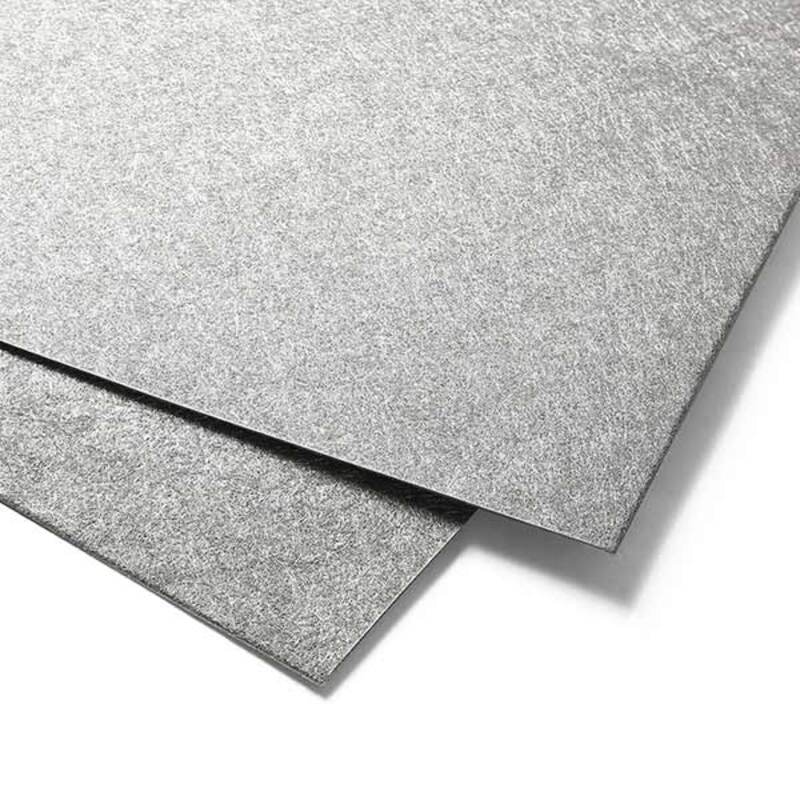
Non-woven metal fibre felt for fine and deep filtration=
Product technical dossier | Rev. 1.0 | September 2026
Sintered metal fibre felt is a non-woven porous material made from stainless steel or alloy fibres that are ground, lapped and laminated, then diffusion-bonded by high-temperature sintering. Because the fibres form a three-dimensional random network rather than a woven grid, the felt offers higher porosity, a more uniform pore distribution and a much greater dirt-holding capacity than wire cloth. It can be welded and pleated, is supplied as flat sheets, and is commonly laminated with sintered wire mesh or built up in multiple layers to form filter cartridges and pleated elements.
Key facts at a glance
| Product |
Sintered metal fibre felt (non-woven, diffusion bonded) |
| Filtration rating |
1 µm to 80 µm for liquids; below 0.1 µm achievable in air and gases |
| Standard materials |
SS316L, SS316, SS304, nickel |
| Special materials on request |
FeCrAl, titanium |
| Porosity |
up to 85 % |
| Nominal thickness |
0.30 mm to 0.68 mm (standard grades) |
| Sheet size range |
500 × 1000 mm up to 1500 × 1800 mm (maximum) |
| Max. service temperature |
up to 1000 °C |
1. Description and construction
Metal fibre felt is produced by laying metal fibres into a non-woven web, lapping and laminating the web to the required areal weight, and then sintering it under vacuum or in a protective atmosphere at a temperature below the melting point of the alloy. At the contact points the fibres diffusion-bond into a rigid three-dimensional network, so the felt holds its shape without any binder and can be handled, cut, pleated and welded like a metal sheet.
The pore structure is the key difference from woven mesh. Wire cloth filters at its surface, with pores defined by the weave; felt filters through the full depth of the fibre web, so particles are captured throughout the medium instead of building up a cake on the face. This gives felt a far higher dirt-holding capacity and a longer on-stream life, and it is why a felt layer is frequently added to a sintered mesh or sintered filter element to upgrade its performance.
2. Material composition
| Material |
Designation |
Where it is used |
| Stainless steel 316L |
UNS S31603 · EN 1.4404 |
Standard grade for filtration duty: molybdenum-bearing, low carbon, resistant to chlorides and most process media. |
| Stainless steel 316 |
UNS S31600 · EN 1.4401 |
Higher-carbon variant where additional strength is required and welding sensitisation is not a concern. |
| Stainless steel 304 |
UNS S30400 · EN 1.4301 |
General-purpose grade for mild chemical, food and air service. |
| Nickel |
UNS N02200 / N02201 |
Alkali and caustic service, electrochemical and hydrogen applications, where stainless steel would corrode. |
| FeCrAl |
Fe-Cr-Al alloy |
High-temperature gas filtration and catalytic supports; oxidation resistant at elevated temperature. |
| Titanium |
UNS R50400 (Gr.2) |
Proton exchange membrane and electrolyser diffusion layers, strongly oxidising media, seawater. |
3. Performance data — standard grade (SSMF series)
The table below gives the characteristic data of the standard metal fibre felt range. Bubble point follows ISO 4003 and air permeability follows ISO 4022; tolerances are ± 5 % on porosity, ± 8 % on bubble point, ± 10 % on air permeability, dirt-holding capacity, thickness and breaking strength.
| Type |
Rating (µm) |
Bubble point (Pa) |
Air perm. (L/min·dm²) |
Porosity (%) |
Dirt holding (mg/cm²) |
Thickness (mm) |
Breaking strength (MPa) |
| SSMF5 |
5 |
6800 |
47 |
75 |
5.0 |
0.30 |
32 |
| SSMF7 |
7 |
5200 |
63 |
76 |
6.5 |
0.30 |
36 |
| SSMF10 |
10 |
3700 |
105 |
77 |
7.6 |
0.37 |
32 |
| SSMF15 |
15 |
2600 |
205 |
80 |
8.0 |
0.40 |
23 |
| SSMF20 |
20 |
1950 |
280 |
81 |
15.5 |
0.48 |
23 |
| SSMF25 |
25 |
1560 |
355 |
80 |
18.4 |
0.62 |
20 |
| SSMF30 |
30 |
1300 |
520 |
80 |
25.0 |
0.63 |
23 |
| SSMF40 |
40 |
975 |
670 |
78 |
25.9 |
0.68 |
26 |
| SSMF60 |
60 |
650 |
1300 |
87 |
35.7 |
0.62 |
28 |
High-pressure grade (SHP series)
The SHP series is a heavier, more compact felt developed for elevated differential pressure. Porosity is slightly lower and breaking strength higher than the equivalent standard grade.
| Type |
Rating (µm) |
Bubble point (Pa) |
Air perm. (L/min·dm²) |
Porosity (%) |
Dirt holding (mg/cm²) |
Thickness (mm) |
Breaking strength (MPa) |
| SHP-20 |
20 |
2050 |
280 |
82 |
18 |
0.68 |
33 (+20 %) |
| SHP-25 |
25 |
1500 |
350 |
80 |
20 |
0.66 |
30 (+20 %) |
| SHP-30 |
30 |
1240 |
500 |
78 |
27 |
0.61 |
32 (+20 %) |
| SHP-40 |
40 |
960 |
650 |
78 |
35 |
0.61 |
36 (+20 %) |
Breaking strength for the SHP series is specified with a +20 % tolerance. Data are typical values for reference; grade selection should be confirmed against the actual medium, flow rate and viscosity of the application.
4. Characteristics and performance
- High porosity, up to 85 % — roughly double that of a woven mesh of comparable rating, which means high flow rate at low pressure drop and lower pumping energy.
- Depth filtration — particles are retained through the thickness of the fibre web, giving high capture efficiency and a large dirt-holding capacity.
- Low pressure drop — the open fibre network keeps the pressure loss across the medium to a minimum for a given flow rate.
- High temperature resistance — operation up to 1000 °C, which non-metallic textile, ceramic or polymer media cannot match.
- Corrosion resistance — available in stainless steel, nickel, titanium and FeCrAl to suit the process medium.
- Long on-stream life — adding a felt layer to a sintered filter medium typically extends service life by a factor of two to three compared with conventional wire-mesh media.
- Enhanced gel and fines removal — particularly effective at capturing gels and fibre debris in polymer spinning and extrusion lines, eliminating fibre breaks.
- Regenerable — the sintered fibre network can be restored by backflushing, ultrasonic cleaning, chemical washing or thermal treatment.
- Formable and weldable — can be pleated, rolled into cylinders and welded without losing its pore structure.
5. Configurations and forms
| Form |
Description |
Typical duty |
| Flat sheet / roll |
Standard sheet 0.30–0.68 mm thick in the sizes listed above. |
Supplied for cutting, stamping and in-house element making. |
| Laminated medium |
Felt layer diffusion-bonded to wire mesh, perforated plate or a support screen. |
Upgrades the dirt-holding capacity and life of a sintered mesh element. |
| Multi-layer felt |
Two or more felt layers sintered into a graded-porosity medium. |
Deep filtration with a coarse pre-filter zone and a fine retention zone. |
| Pleated cartridge |
Pleated felt with a wire-mesh or felt support layer; filtration rating down to 3 µm. |
Polymer and pharmaceutical melts, hydraulic oil, water and high-temperature gas. |
| Cylindrical / candle element |
Felt wrapped or sleeved on a perforated or mesh core, with welded or sintered end fittings. |
In-line liquid and gas filtration in standard housings. |
| Disc and ring |
Felt discs cut or pressed to size. |
Gas sparging, aeration, vent and breather filters. |
6. Test methods and standards
| Property |
Method |
Purpose |
| Bubble point / pore size |
ISO 4003 |
Establishes the largest pore and correlates it to the filtration rating. |
| Air permeability |
ISO 4022 |
Measures flow resistance at standard conditions; used to compare grades and monitor batch consistency. |
| Filtration efficiency (multi-pass) |
ISO 16889 |
Verifies particulate retention efficiency for critical applications. |
| Tensile / breaking strength |
Tensile tester, in-house |
Confirms the mechanical integrity of the felt and of welded or pleated elements. |
| Material verification |
Alloy analyser, C-S analyser |
Confirms the alloy grade and carbon / sulphur content of the fibre and of the finished medium. |
7. Applications
- Polymer filtration — spinning, extrusion and film lines, where gel and fines removal directly affects yarn and film quality.
- High-temperature and corrosive liquid filtration in refineries and chemical plants.
- Gas, water and printing-ink filtration.
- Viscose rayon and fibre production.
- Food and beverage purification and clarification.
- Hydraulic and lubricating oil filtration in machinery and mobile equipment.
- High-temperature gas dust collection.
- Filter media support and catalyst carrier.
- Gas diffusion layer in proton exchange membrane fuel cells and electrolysers (titanium and nickel felt).
- Air and liquid sparging, aeration and fluidisation.
Ordering information
- Filtration rating in µm, and whether nominal or absolute retention is required.
- Material (316L, 316, 304, nickel, FeCrAl, titanium).
- Dimensions: sheet size and thickness, or a drawing for pleated and cylindrical elements.
- Operating temperature, pressure, flow rate and process medium (for grade and thickness selection).
- Whether the felt is required as plain sheet, laminated onto a support, or as a finished element.
- Quantity, and whether material certificates or test records are required.
Contact
| Address |
NO15, Building 1, B Zone, Wire Mesh World, Anping County, Hengshui City, Hebei Province, China 053600 |
| Mobile |
+86-170 6528 1888 |
| Tel |
86-0318-5280116 |
| Fax |
86-0318-7020860 |
| Website |
www.metalmeshfilters.com | www.bolinmetalmesh.com |
All technical data in this document are typical values measured on standard production and are given for engineering reference only; they do not constitute a warranty of performance in a specific application. Tolerances and final specifications are confirmed at the time of order. Please contact us before specifying a filter medium for a safety-critical duty.
Anping County Bolin Metal Wire Mesh Co., Ltd. | Focus on wire mesh manufacturing for more than 15 years.