Porous sintered metal powder filter media and elements
Product technical dossier | Rev. 1.0 | September 2026
Powder sintered products are porous metal components made by cold isostatic pressing metal powder into shape and then vacuum sintering it below the melting point, without any binder or adhesive. At the sintering temperature the powder particles diffusion-bond at their contact points, leaving a rigid, self-supporting body with a fully interconnected pore network. Because pore size, porosity and permeability are set by the powder grade and the compaction parameters, the filtration performance of the finished part can be specified and repeated in production.
Key facts at a glance
| Product |
Sintered metal powder filter media, discs, tubes, cartridges and plates |
| Mean pore size |
0.5 µm to 150 µm (2–100 µm typical) |
| Porosity |
20 % to 50 % |
| Media thickness |
1 mm to 10 mm |
| Materials |
Bronze, SS316L, SS304L, iron-copper, nickel, titanium, Monel, Inconel, Hastelloy |
| Configurations |
Discs, tubes / candles, cartridges, flat plates |
| Max. service temperature |
up to 600 °C (316L); approx. 250 °C (bronze) |
| Typical burst pressure |
50 to 300 bar, depending on porosity, wall thickness and diameter |
1. Description and manufacturing route
The process gives a rigid structure with a three-dimensional pore network, which is what distinguishes powder sintered elements from woven mesh or paper media. It also means the porosity can be graded through the wall thickness — a coarse support zone behind a fine retention zone — to raise dirt-holding capacity while keeping the pressure drop low. Typical production steps:
- Powder selection — the powder particle size distribution is matched to the target pore size and permeability.
- Cold isostatic pressing — the powder is formed into the required shape at high and uniform pressure, without additives.
- Vacuum sintering — the green body is sintered at high temperature under vacuum or protective atmosphere; the particles diffusion-bond at contact points.
- Secondary operations — machining, sizing, welding or sinter-bonding of end fittings to the required interface.
- Inspection — bubble point, permeability and dimensional checks before despatch.
2. Material composition
| Material |
Max. service temperature |
Where it is used |
| Bronze (Cu-Sn) |
approx. 250 °C |
General-purpose air, oil and low-pressure hydraulic filtration; pneumatic silencers and mufflers; compatible with oil-based fluids and self-lubricating in some configurations. |
| Stainless steel 316L |
500–600 °C |
The standard material for industrial sintered filters: corrosion resistant in water, mild chemicals, hydrocarbon fluids and food-contact service; cleanable in place and steam sterilisable. |
| Stainless steel 304L |
up to approx. 500 °C |
General-purpose stainless route where 316L corrosion resistance is not required. |
| Nickel |
high temperature |
Alkali and caustic service, electrochemical duty and where stainless steel would corrode. |
| Titanium |
high temperature |
Strongly oxidising media, seawater and hydrogen applications. |
| Monel (Ni-Cu) |
high temperature |
Seawater, hydrofluoric acid and alkaline media. |
| Inconel (Ni-Cr-Fe) |
above 600 °C |
Extreme temperature and oxidising service. |
| Hastelloy B / C / X |
high temperature |
Strong acids, chlorides and oxidising environments where stainless steel fails. |
| Iron / iron-copper |
approx. 400 °C |
Lower-cost option for air filtration, low-temperature gas and flame arrestors where corrosion resistance is not critical (higher with coating or steam treatment). |
3. Specification range
| Parameter |
Typical range |
Notes |
| Mean pore size |
0.5 µm – 150 µm |
Set by powder grade and compaction. Finer than 5 µm requires special powder grades and tighter process control. |
| Porosity |
20 % – 50 % |
Higher porosity gives more flow but less strength; lower porosity gives more strength and efficiency but higher pressure drop. |
| Media thickness |
1 mm – 10 mm |
Thicker media improve depth filtration. |
| Max. operating temperature (316L) |
up to 600 °C |
Depends on atmosphere and mechanical load. |
| Max. operating temperature (bronze) |
up to 250 °C |
Limited by alloy softening. |
| Typical burst pressure |
50 – 300 bar |
Depends on porosity, wall thickness and diameter. |
| Clean pressure drop in air |
0.01 – 2.0 bar |
Varies widely with pore size and face velocity. |
4. Configurations and dimensions
| Configuration |
Typical dimensions |
Where it is used |
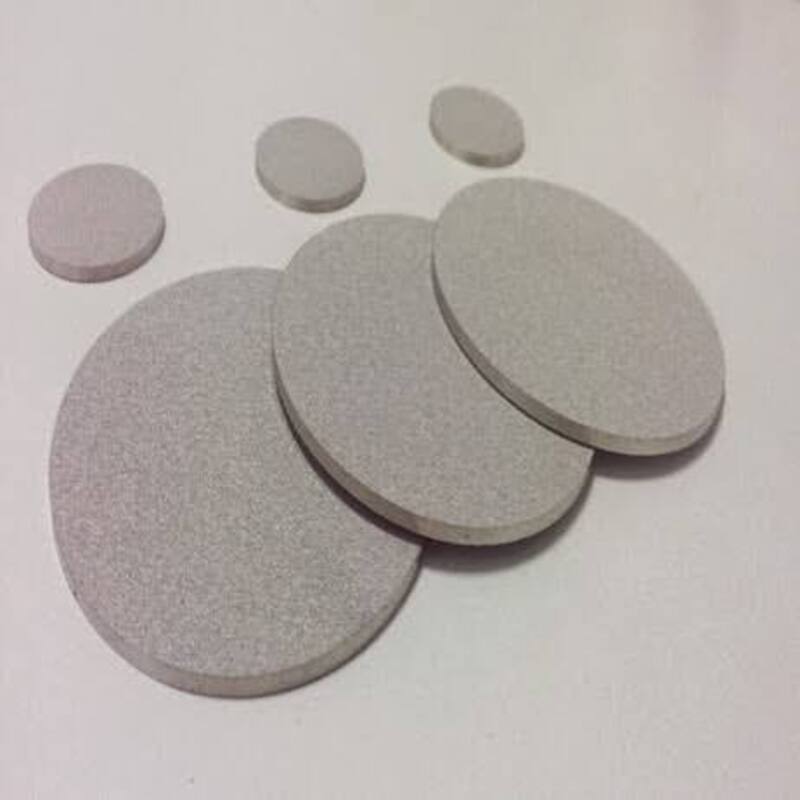
| Disc |
Diameter 5–200 mm; thickness 1–10 mm; porosity 20–40 % typical. |
In-line filtration, flow restriction, hydraulic bypass filtration, pneumatic mufflers, gas spargers and breather vents. |
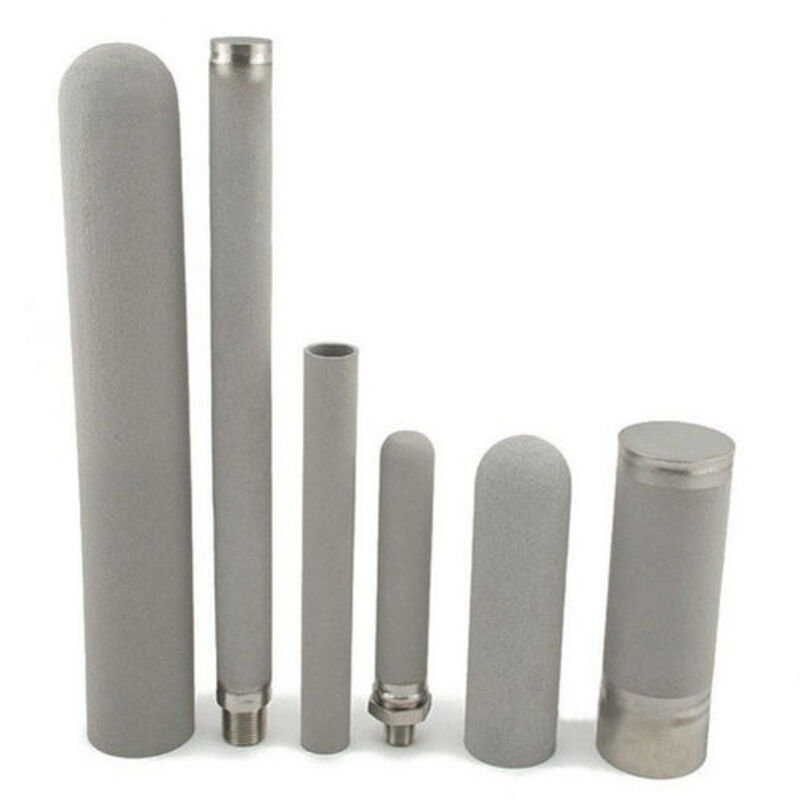
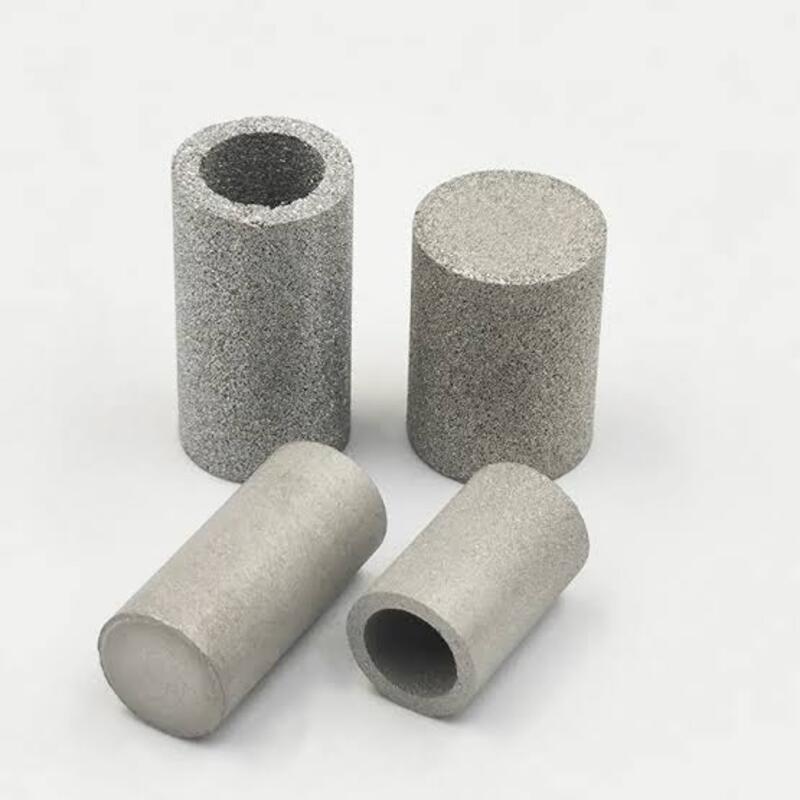
| Tubular element / candle |
Outer diameter 6–100 mm (standard steps 20, 25, 30, 40, 50, 60, 70, 80, 90, 100, 140 mm); length 20–1500 mm (longer lengths by welding); wall thickness 1–5 mm. |
Chemical process streams, catalyst filtration, polymer filtration, mother-liquor recovery in PTA, compressed gas drying. |
| Cartridge |
Single-layer or graded-porosity construction; end fittings welded, threaded, flanged or sealed to the housing specification. |
High-pressure hydraulics, food and beverage processing, pharmaceutical filtration, drop-in replacement in standard housings. |
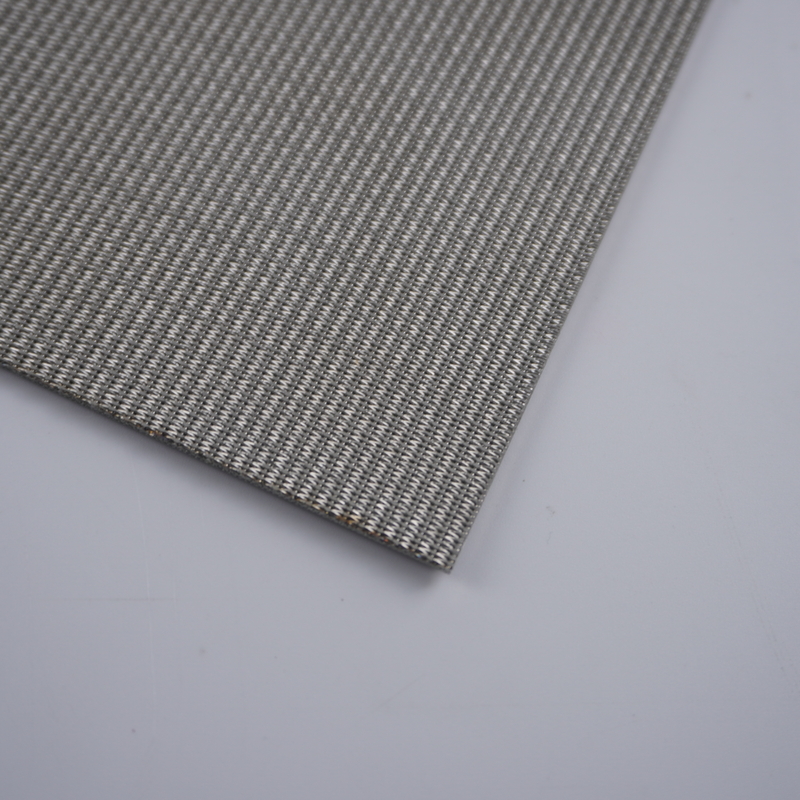
| Sheet / plate |
Typically up to 300 × 300 mm; thickness 1–6 mm; machinable, weldable and formable. |
Flame arrestors, air distribution plates, EMI shielding, fluidised-bed components. |
Elements can be supplied in tubular form with a wide choice of interfaces, bonded by welding or directly during sintering. Special specifications, larger discs, longer elements and multi-layer cartridges are produced to customer drawing.
5. Characteristics and advantages
- Rigid and self-supporting — the sintered matrix needs no support cage and does not shed fibres or particles into the process stream.
- Depth filtration — the three-dimensional pore network captures particles through the wall thickness, giving higher dirt-holding capacity than a surface screen of the same rating.
- Graded porosity — a coarse support zone and a fine retention zone can be built into one part to improve capacity and reduce pressure drop.
- Reusable — regenerated by backflushing, ultrasonic cleaning in solvent, chemical washing or thermal oxidation, extending service life from months to years.
- High pressure capability — differential pressures above 100 bar are feasible in robust designs; thickness is easily adjusted to suit the duty.
- High temperature capability — stainless grades to 600 °C and nickel alloys above that, from cryogenic conditions upwards.
- Precisely controlled porosity — consistent, predictable flow rate from part to part and batch to batch.
- Almost unlimited design freedom — the forming route allows shapes, bores, steps and interfaces that would be difficult or impossible to produce from woven media.
- No adhesive or binder — the bond is metallurgical, so there is nothing to leach or degrade in aggressive media.
6. Applications
| Industry |
Typical duty |
| Hydraulic and pneumatic systems |
Bypass filtration, pressure-regulator inserts and servo-valve guards protecting pumps, valves and actuators; bronze and stainless mufflers that attenuate exhaust noise while blocking contaminants. |
| Chemical processing |
Catalyst recovery, polymer filtration and solvent clarification in 316L and nickel alloys; cleanable media make long service intervals economical. |
| Oil and gas |
Flame arrestors, vent and sampler filters, pipeline particulate control and sand control; metal media provide a safety margin where media failure is not acceptable. |
| Food and beverage |
Steam filtration, gas sparging in fermentation and final product clarification; cleanable in place, steam sterilisable and non-shedding. |
| Pharmaceutical and biopharmaceutical |
Sterile gas and liquid filtration, catalyst and intermediate separation, fixed-bed enzyme reactor service. |
| Power generation |
High-temperature liquid and gas filtration, steam filtration and combustion-plant particulate control. |
| Gas sparging and aeration |
Fine, uniform bubble generation in wastewater treatment, bioreactors and carbonation, with sparger pores typically 10–100 µm. |
| HVAC and compressors |
Refrigerant circuit protection, compressor oil return, intake filtration, porous mufflers and breather elements. |
| Petroleum refining |
Process-stream and catalyst fines removal, high-temperature filtration, PTA mother-liquor recovery. |
7. Comparison with other filter media
| Aspect |
Powder sintered |
Wire mesh |
Paper / polymer |
| Filtration mechanism |
Depth (3-D pore network) |
Surface |
Depth, single use |
| Cleanability |
Excellent; fully regenerable |
Good; backwashable |
Not cleanable |
| Max. temperature |
Up to 600 °C and above |
Up to 480 °C |
Typically below 120 °C |
| Structural integrity |
Self-supporting, rigid |
Strong but can fray or fatigue |
Requires a support cage |
| Porosity grading |
Possible through wall thickness |
By layering screens |
Not applicable |
| Best suited to |
Harsh service and long-life duty |
Fine surface retention |
Low-cost, low-temperature duty |
This table is a general engineering comparison for guidance; selection depends on the specific fluid, temperature, pressure and cleanliness requirement of the application.
8. Quality control and verification
| Check |
Method |
What is verified |
| Pore size / filtration rating |
Bubble point test, ASTM F316 |
Pressure required to force air through the wetted element, correlated to the largest pore diameter. |
| Permeability |
Air permeability test, ISO 4022 |
Flow resistance at standard conditions. |
| Retention efficiency |
Multi-pass test, ISO 16889 |
Particulate retention efficiency for critical applications. |
| Dimensional |
Caliper, gauge and interface inspection |
Wall thickness, bore, length and sealing-face tolerances. |
| Material |
Alloy analyser, C-S analyser |
Alloy grade and carbon / sulphur content of powder and finished part. |
| Documentation |
Material certificate / inspection report |
Full traceability to batch, issued with the shipment on request. |
Ordering information
- Pore size or filtration rating in µm, and whether nominal or absolute retention is required.
- Material preference (316L, bronze, nickel, titanium, Monel, Inconel, Hastelloy).
- Operating pressure and temperature, and the process medium.
- Required flow rate and allowable pressure drop.
- Configuration (disc, tube, cartridge, plate) and dimensional drawing including sealing faces and interfaces.
- Intended cleaning method and frequency, plus the target annual volume.
Contact
| Address |
NO15, Building 1, B Zone, Wire Mesh World, Anping County, Hengshui City, Hebei Province, China 053600 |
| Mobile |
+86-170 6528 1888 |
| Tel |
86-0318-5280116 |
| Fax |
86-0318-7020860 |
| Website |
www.metalmeshfilters.com | www.bolinmetalmesh.com |
All technical data in this document are typical values measured on standard production and are given for engineering reference only; they do not constitute a warranty of performance in a specific application. Tolerances and final specifications are confirmed at the time of order. Please contact us before specifying a filter medium for a safety-critical duty.
Anping County Bolin Metal Wire Mesh Co., Ltd. | Focus on wire mesh manufacturing for more than 15 years.