Flexible Stainless Steel Wire Rope Mesh with Crimped Ferrules
Product Technical Guide | Description · Specifications · Features · Material · Performance · Applications
1. Product Description
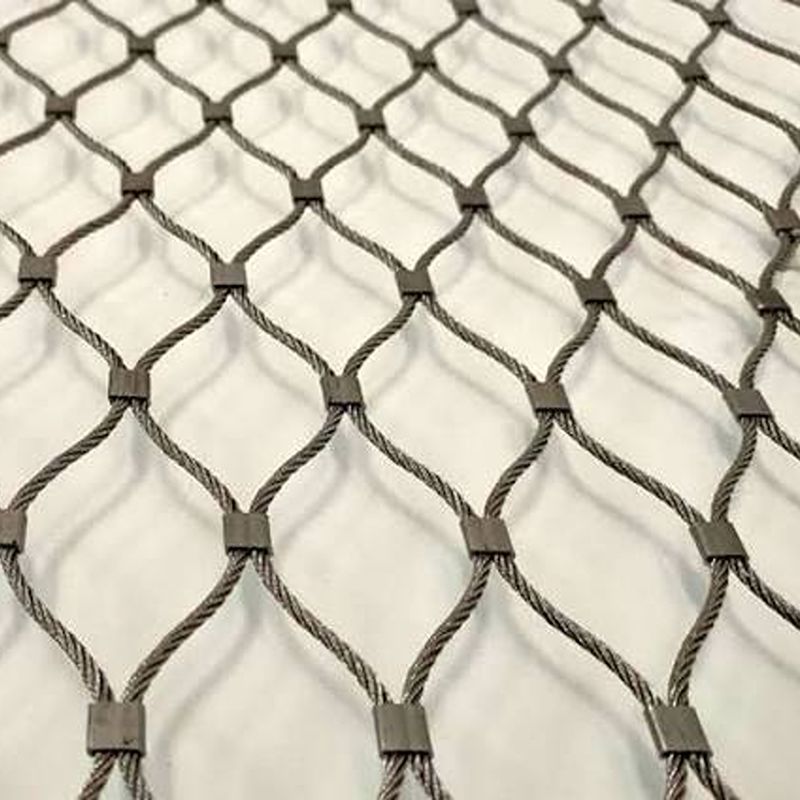
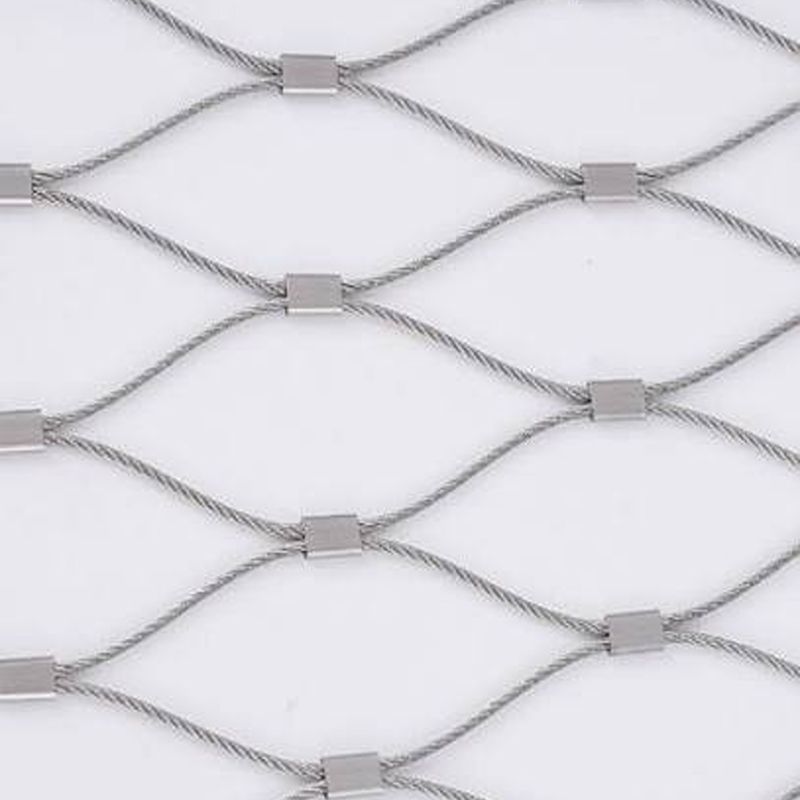
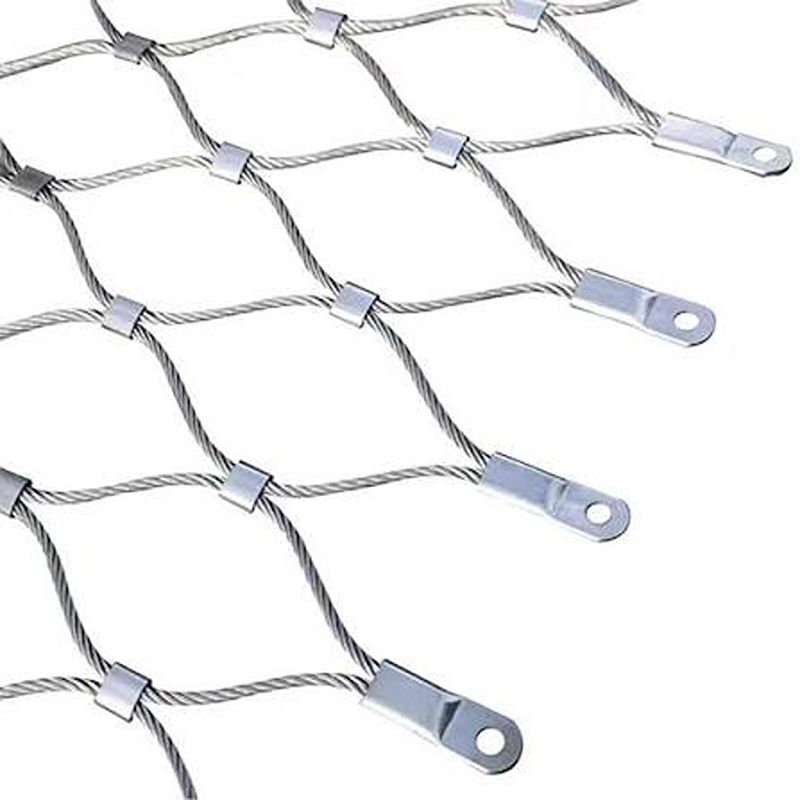
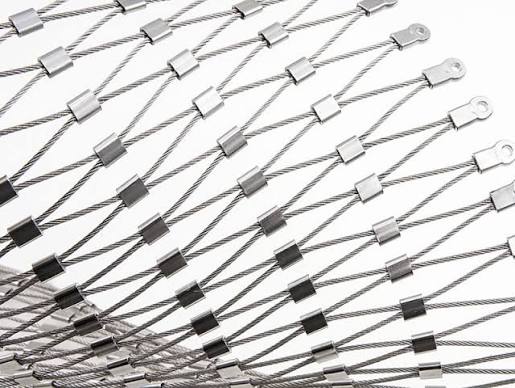
Stainless steel ferrule rope mesh is a flexible metal netting in which stainless steel wire ropes are joined at every intersection by a stainless steel ferrule (sleeve) that is hydraulically crimped onto both ropes. The crimped joint fixes the rope position permanently, producing an open diamond mesh that is at the same time rigid enough to hold its geometry and flexible enough to be folded, rolled and shaped.
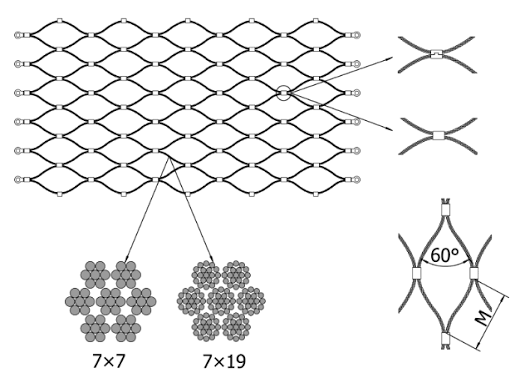
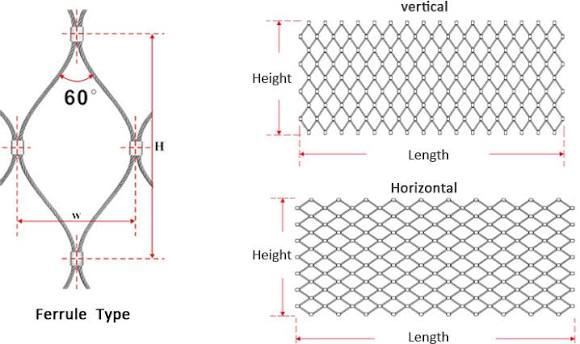
The mesh is produced from austenitic stainless steel wire rope in AISI 304, 304L, 316 or 316L, and every component – rope, ferrule, edge rope and clamp – is made of stainless steel so that no dissimilar-metal contact is introduced. Depending on the rope diameter the rope is built to a 7 × 7 or a 7 × 19 construction. At the standard opening angle of 60° the apertures form a regular diamond pattern, and other opening angles allow the transparency and the strength of the panel to be matched to the design.
The combination of a high strength-to-weight ratio, a refined appearance and complete flexibility has made ferrule rope mesh a standard element of contemporary architectural decoration and protection. Typical uses are public and private balustrades, zoo animal enclosures, bird netting, safety fencing, green planting systems and facade and canopy screens.
Compared with knotted rope mesh, ferrule rope mesh is the more flexible and the more refined of the two constructions, with a slightly lower strength at equal rope diameter. Both types share the same raw material, the same fixing accessories and the same design language, and they are often used together in one project.
2. Key Features & Characteristics
- Reliable, machine-crimped joints. Each crossing is locked by a stainless steel ferrule that is hydraulically crimped onto both ropes, producing a consistent, reproducible joint that does not loosen under vibration or repeated loading.
- Simple and fast assembly. Because the ropes are fixed by ferrules rather than tied by hand, the mesh is produced quickly and uniformly, which shortens lead time and gives a repeatable, checked panel every time.
- High strength-to-weight ratio. The load is carried by continuous stainless steel ropes, so a very open mesh achieves a high load capacity at a low self-weight.
- Flexible, foldable and easy to transport. The mesh bends and folds without loss of strength or safety, can be rolled into compact coils, and is therefore economic to ship and easy to move and lift on site.
- Refined appearance. The ferrule is compact and unobtrusive, so the mesh reads as a clean, light, near-invisible surface – the reason ferrule mesh is the preferred type for high-end architectural and zoo work.
- Excellent corrosion and weather resistance. 304, 304L, 316 and 316L grades perform indoors and outdoors; the exceptional weather resistance of the stainless grades makes them ideal for permanent external installations.
- Unique design freedom. Every panel is designed and manufactured to the specific project: rope diameter, opening size and mesh aperture are all selectable, giving the designer a wide range of possibilities.
- Two ferrule types. Both closed-ferrule and opened-ferrule construction are available; the opened type is used where a particular edge or connection detail is required.
- Non-combustible. Adds no fuel load and generates no toxic smoke.
3. Construction & Mesh Geometry
- Rope diameter D – 2 mm (3/64"), 1.6 mm (1/16"), 2.0 mm (5/64"), 2.4 mm (3/32"), 3.2 mm (1/8"), 4.0 mm (5/32").
- Rope construction – 7 × 7 for 1.2–2.4 mm rope; 7 × 19 for 3.2 mm and above.
- Mesh aperture M – from 20 × 20 mm to 203 × 203 mm as standard; other apertures to order.
- Opening angle – 20°, 30°, 60°, 70° and 75° are standard; the optimum stretched condition is 60°.
- Ferrule type – closed ferrule or opened ferrule.
- Panel size and shape – made to measure, including curved, tapered and non-rectangular panels.
In the specification code, M denotes the mesh aperture (the opening measured between the ropes) and D denotes the wire rope diameter. The opening angle is the angle between the two rope directions at a crossing; at the standard 60° the diamond opening is close to equilateral, which is the optimum stretched condition. Smaller angles produce a narrow, elongated diamond and a denser surface; larger angles produce a more open mesh with higher light transmission.
4. Material & Chemical Composition
Wire rope and mesh are produced from austenitic stainless steel, supplied to AISI 304, 304L, 316 and 316L and inspected against ISO/TS 15510:2003. Each production lot is checked before shipment and can be issued with an EN 10204 Type 3.1 mill test certificate on request.
Table 4.1 – Chemical composition (%).
| Grade |
C |
Si |
Mn |
Cr |
Ni |
S |
P |
| 304 |
≤ 0.07 |
≤ 1.0 |
≤ 2.0 |
17.0–19.0 |
8.0–11.0 |
≤ 0.03 |
≤ 0.035 |
| 304L |
≤ 0.03 |
≤ 1.0 |
≤ 2.0 |
17.0–19.0 |
8.0–12.0 |
≤ 0.03 |
≤ 0.035 |
| 316 |
≤ 0.08 |
≤ 1.0 |
≤ 2.0 |
16.0–18.5 |
10.0–14.0 |
≤ 0.03 |
≤ 0.035 |
| 316L |
≤ 0.03 |
≤ 1.0 |
≤ 2.0 |
16.0–18.0 |
12.0–15.0 |
≤ 0.03 |
≤ 0.045 |
- 304 / 304L – general-purpose grade for normal atmospheric, indoor and rural environments. The low-carbon 304L variant limits carbide precipitation and is preferred where welding or heavy forming is involved.
- 316 / 316L – contain 2–3% molybdenum, which forms a denser and more stable passive film. This markedly improves resistance to chloride-ion attack, so 316/316L are selected for coastal, marine, swimming-pool and high-humidity installations, and for applications requiring higher heat resistance.
- Ferrule / knot hardware – the ferrules used to join the ropes, and the edge clamps and tensioning accessories, are made of matching stainless steel so that no dissimilar-metal contact is introduced on site.
5. Standard Specifications
Table 5.1 – Standard ferrule rope mesh range. Rope diameter, mesh aperture, panel size and ferrule type can all be produced to order beyond this range.
| Ref. |
Rope structure |
Rope dia. (inch / mm) |
Mesh aperture M (inch) |
Mesh aperture M (mm) |
Min. breaking force (kN) |
| 4076F |
7 × 19 |
5/32" / 4.0 |
3" × 3" |
76 × 76 |
10.7 |
| 4090F |
7 × 19 |
5/32" / 4.0 |
3.6" × 3.6" |
90 × 90 |
10.7 |
| 40102F |
7 × 19 |
5/32" / 4.0 |
4" × 4" |
102 × 102 |
10.7 |
| 40127F |
7 × 19 |
5/32" / 4.0 |
5" × 5" |
127 × 127 |
10.7 |
| 40152F |
7 × 19 |
5/32" / 4.0 |
6" × 6" |
152 × 152 |
10.7 |
| 40203F |
7 × 19 |
5/32" / 4.0 |
8" × 8" |
203 × 203 |
10.7 |
| 32152F |
7 × 19 |
1/8" / 3.2 |
6" × 6" |
152 × 152 |
7.38 |
| 32127F |
7 × 19 |
1/8" / 3.2 |
5" × 5" |
127 × 127 |
7.38 |
| 32120F |
7 × 19 |
1/8" / 3.2 |
4.7" × 4.7" |
120 × 120 |
7.38 |
| 32102F |
7 × 19 |
1/8" / 3.2 |
4" × 4" |
102 × 102 |
7.38 |
| 3290F |
7 × 19 |
1/8" / 3.2 |
3.6" × 3.6" |
90 × 90 |
7.38 |
| 3276F |
7 × 19 |
1/8" / 3.2 |
3" × 3" |
76 × 76 |
7.38 |
| 3260F |
7 × 19 |
1/8" / 3.2 |
2.4" × 2.4" |
60 × 60 |
7.38 |
| 3251F |
7 × 19 |
1/8" / 3.2 |
2" × 2" |
51 × 51 |
7.38 |
| 24152F |
7 × 7 |
3/32" / 2.4 |
6" × 6" |
152 × 152 |
4.18 |
| 24127F |
7 × 7 |
3/32" / 2.4 |
5" × 5" |
127 × 127 |
4.18 |
| 24102F |
7 × 7 |
3/32" / 2.4 |
4" × 4" |
102 × 102 |
4.18 |
| 2490F |
7 × 7 |
3/32" / 2.4 |
3.6" × 3.6" |
90 × 90 |
4.18 |
| 2476F |
7 × 7 |
3/32" / 2.4 |
3" × 3" |
76 × 76 |
4.18 |
| 2460F |
7 × 7 |
3/32" / 2.4 |
2.4" × 2.4" |
60 × 60 |
4.18 |
| 2451F |
7 × 7 |
3/32" / 2.4 |
2" × 2" |
51 × 51 |
4.18 |
| 2076F |
7 × 7 |
5/64" / 2.0 |
3" × 3" |
76 × 76 |
3.17 |
| 2060F |
7 × 7 |
5/64" / 2.0 |
2.4" × 2.4" |
60 × 60 |
3.17 |
| 2051F |
7 × 7 |
5/64" / 2.0 |
2" × 2" |
51 × 51 |
3.17 |
| 2038F |
7 × 7 |
5/64" / 2.0 |
1.5" × 1.5" |
38 × 38 |
3.17 |
| 16102F |
7 × 7 |
1/16" / 1.6 |
4" × 4" |
102 × 102 |
2.17 |
| 1676F |
7 × 7 |
1/16" / 1.6 |
3" × 3" |
76 × 76 |
2.17 |
| 1660F |
7 × 7 |
1/16" / 1.6 |
2.4" × 2.4" |
60 × 60 |
2.17 |
| 1651F |
7 × 7 |
1/16" / 1.6 |
2" × 2" |
51 × 51 |
2.17 |
| 1638F |
7 × 7 |
1/16" / 1.6 |
1.5" × 1.5" |
38 × 38 |
2.17 |
| 1630F |
7 × 7 |
1/16" / 1.6 |
1.2" × 1.2" |
30 × 30 |
2.17 |
| 1625F |
7 × 7 |
1/16" / 1.6 |
1" × 1" |
25.4 × 25.4 |
2.17 |
| 12102F |
7 × 7 |
3/64" / 1.2 |
4" × 4" |
102 × 102 |
1.22 |
| 1276F |
7 × 7 |
3/64" / 1.2 |
3" × 3" |
76 × 76 |
1.22 |
| 1251F |
7 × 7 |
3/64" / 1.2 |
2" × 2" |
51 × 51 |
1.22 |
| 1238F |
7 × 7 |
3/64" / 1.2 |
1.5" × 1.5" |
38 × 38 |
1.22 |
| 1230F |
7 × 7 |
3/64" / 1.2 |
1.2" × 1.2" |
30 × 30 |
1.22 |
| 1225F |
7 × 7 |
3/64" / 1.2 |
1" × 1" |
25.4 × 25.4 |
1.22 |
| 1220F |
7 × 7 |
3/64" / 1.2 |
0.8" × 0.8" |
20 × 20 |
1.22 |
6. Mechanical Performance & Breaking Load
The minimum breaking force in Table 5.1 is the load at which the wire rope used in the panel fails in tension; it is the basis for design. The table shows that the breaking force is set by the rope diameter rather than by the aperture, so the aperture can be chosen almost freely to suit the visual and containment requirement.
Table 6.1 – Minimum breaking force of the wire rope by diameter.
| Wire rope diameter |
Rope structure |
Minimum breaking force (kN) |
| 1.2 mm (3/64") |
7 × 7 |
1.22 |
| 1.6 mm (1/16") |
7 × 7 |
2.17 |
| 2.0 mm (5/64") |
7 × 7 |
3.17 |
| 2.4 mm (3/32") |
7 × 7 |
4.18 |
| 3.2 mm (1/8") |
7 × 19 |
7.38 |
| 4.0 mm (5/32") |
7 × 19 |
10.7 |
- Panel rated load. The rated breaking load of a finished panel also depends on joint efficiency, the number of ropes carrying the load and the edge termination. Mesh-level values are confirmed by the tensile test report for each production lot.
- Design safety factor. Safety factors for safety-critical installations – balustrades, fall-protection and crowd barriers – are set by the applicable local standard or project specification. Please confirm the required factor before the design is finalised so that the rope diameter can be selected accordingly.
- 7 × 7 versus 7 × 19. 7 × 7 rope is stiffer and holds its shape better, which suits small-aperture architectural panels; 7 × 19 rope is more flexible and tolerates repeated bending better, which suits large-aperture panels and installations that are rolled or folded frequently.
7. Service Performance & Durability
- Corrosion resistance. 304 / 304L resist atmospheric, fresh-water and rural or urban exposure. 316 / 316L contain molybdenum, which forms a denser and more stable passive film and markedly improves resistance to chloride-ion attack, so they are preferred for coastal, marine, swimming-pool and de-icing-salt environments.
- Weather and UV. The mesh contains no polymer component, so it is not affected by ultraviolet light; transparency and mechanical properties do not degrade with sun exposure.
- Austenitic stainless steel retains its mechanical properties over a wide service temperature range. Continuous service of unstabilised 304 / 316 in the chromium-carbide precipitation range (approximately 425–815 °C) is not recommended; the low-carbon 304L / 316L grades are used where welded assemblies are exposed to elevated temperature.
- Impact behaviour. The mesh is elastic: on impact it deflects and recovers, absorbing energy rather than shattering. Where large deflections are possible, intermediate supports or a tensioned perimeter should be provided.
- Contact and abrasion. Contact with claws, beaks or fur does not damage the stainless surface; in animal enclosures the ferrules and clamps should be inspected periodically for deformation.
- Non-combustible, adds no fuel load to the building and generates no toxic smoke.
8. Comparison: Knotted vs. Ferrule Rope Mesh
Both constructions share the same flexible diamond opening, the same stainless steel raw material and the same fixing systems. They differ in how the wire ropes are locked together, which drives the strength / flexibility trade-off.
| Aspect |
Knotted Rope Mesh |
Ferrule Rope Mesh |
| Joint method |
Ropes are interwoven and tied with a knot at every intersection |
Ropes are joined at every intersection by a stainless steel ferrule (sleeve) that is hydraulically crimped |
| Relative strength |
Higher: the knot locks the rope against slippage and the assembly is the stronger of the two |
Slightly lower than the knotted type at equal rope diameter |
| Flexibility & appearance |
Less flexible; the knot is visible and reads as a more "textile" surface |
More flexible and more refined in appearance; the ferrule is compact and unobtrusive |
| Assembly |
Hand-knotted – more labour, longer lead time |
Machine-crimped – fast, consistent, highly repeatable |
| Preferred when |
Mechanical strength, animal containment and heavy loading come first |
Visual refinement, tight curvature, complex geometry and fast delivery come first |
9. Typical Applications
- Zoo and wildlife enclosures – large cats, primates, bears, birds and reptiles: high strength with clear sight-lines for visitors.
- Bird aviaries and bird netting – including walk-through aviaries where transparency and light transmission matter.
- Balustrades, handrails and guardrails – atria, stairwells, terraces, mezzanines and car parks.
- Bridge and viaduct balustrade infill panels.
- Building facades and architectural decoration – screens, canopies, sunshades and cladding features.
- Green walls and plant climbing systems – the mesh acts as a climbing trellis and support frame for climbing plants.
- Safety netting – stadium, atrium, helideck and general fall-protection netting.
- Parking structures, ramps and stair cores.
- Sports and leisure facilities – ball-stop and driving-range netting.
- Cable railing and stainless steel rope systems.
10. Ordering & Customization
Every panel is made to measure. Please provide the following parameters when requesting a quotation:
- Required material grade (304, 304L, 316 or 316L).
- Wire rope diameter in mm or inch.
- Mesh opening (aperture) size, and the opening angle if other than the standard 60°.
- Panel width × height, or the total surface area with a project drawing.
- Edge condition: edge rope, edge plate, or plain cut panel.
- Fixing method: clamps, tensioning cables, frames or posts, and whether accessories are required.
- Quantity, destination port and required delivery date.
Tolerances: mesh opening and panel dimensions are subject to the normal manufacturing tolerance for flexible rope mesh. Because the mesh is elastic, panels are quoted with an installation allowance; final dimensions should always be confirmed against the approved shop drawing.
11. Installation, Packaging & Maintenance
Installation
- Panels are supplied pre-formed and cut to size. Because the mesh is elastic, it can be shaped and adjusted on site without loss of strength.
- Fix the panel to the support structure with stainless steel clamps, edge plates or tensioning cables. Fixings should match the mesh grade to avoid galvanic corrosion.
- Tension the panel progressively from the corners towards the middle so that the diamond openings close to their designed 60° opening angle.
- For tall installations, split the height into separate panels and provide intermediate supports so that no single panel carries the full height load.
Packaging
- Ferrule rope mesh is flexible and can be folded or rolled, so panels are rolled into coils and packed in cartons or plywood cases. Packing volume is small compared with rigid mesh, which reduces freight cost and site storage space.
Maintenance
- No painting, coating or periodic re-treatment is required.
- Clean with clean water and a mild neutral detergent; for coastal sites rinse periodically to remove salt deposits.
- Inspect joints, clamps and tensioning elements at intervals; re-tension if the panel has been deformed by impact.
- Austenitic stainless steel is non-combustible and contributes no fuel load to a building.
12. Quality Assurance & Inspection
Incoming wire rope is verified for diameter, construction and breaking load before weaving. Finished mesh is inspected lot by lot against the following checkpoints:
- Wire rope diameter and construction (7 × 7 / 7 × 19).
- Mesh aperture and ferrule spacing / knot spacing.
- Panel dimensions, squareness and edge condition.
- Surface condition – no scratches, oil marks, broken wires or burrs.
- Material grade verification by chemical analysis and, where required, a tensile test on the rope.
Documentation available on request: EN 10204 Type 3.1 mill test certificate, dimensional inspection report, packing list and certificate of origin.